🚀 Download Platform | 🔒 Secure Payment | ⚙️ 3D Files for Recreational Equipment | 🏆 3D Models Designed for Additive Manufacturing | 2D, 3D, STL, SVG, PDF... | ❤️ Core Values | 💬 Tips, Tricks, and Discussions
Why Are Free 3D Models So Often Resold? An Analysis of the Business Model of Download Platforms


Sharing STL files has played a major role in making 3D printing accessible to everyone. Platforms such as Thingiverse, Cults3D, Printables, MakerWorld, MyMiniFactory, and Thangs now give millions of users access to a vast catalog of designs.
This distribution model has fostered innovation, accelerated the exchange of knowledge, and enabled many designers to showcase their work. But as 3D printing becomes a genuine means of production, new questions are arising.
Why are there so many 3D-printed items on the market that are based on models that were originally distributed for free?
Why are some designers gradually moving away from open sharing?
Why are functional models increasingly being offered under commercial licenses rather than as free downloads?
These developments are not the result of chance. They stem directly from the business models that currently shape the 3D printing ecosystem.
A download platform is not an engineering firm
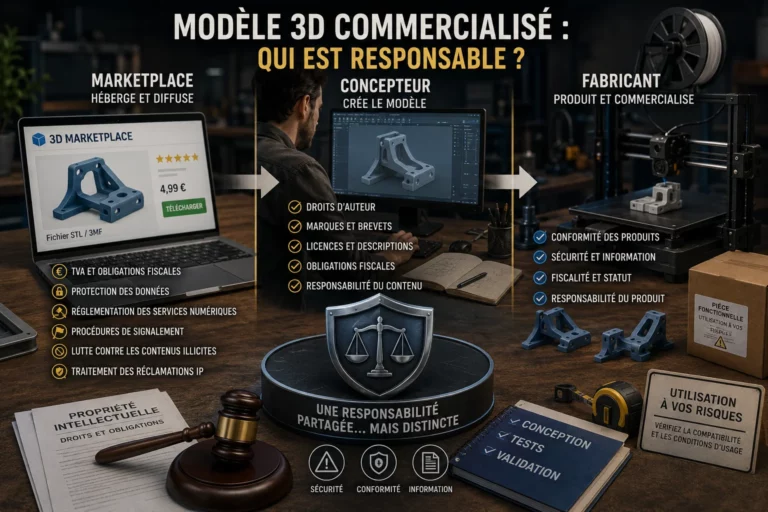
The first distinction to be made concerns the roles of the various stakeholders. A download platform is generally not intended to design 3D models.
His job involves:
- host digital files; ;
- make sure that the files do not
- organize their distribution; ;
- connect designers and users; ;
- enforce the laws (taxation,
- to process transactions when the models are released to the market.
Its business is therefore comparable to that of a specialized marketplace.
The designer, for his part, takes on all of the creative work:
- needs analysis; ;
- design; ;
- prototyping; ;
- tests; ;
- improvements; ;
- documentation.
This distinction explains why the quality of a model depends first and foremost on the designer himself.
Economic interests are not the same
All players in the 3D printing industry are pursuing perfectly legitimate goals. They simply do not create the same value… and do not generate revenue in the same way.
| Actor | What he produces | Main Sources of Revenue |
|---|---|---|
| Platform | An infrastructure for dissemination, research, and networking | Commissions on sales, subscriptions, advertising, partnerships, promotion of products or services, and development of their ecosystem |
| Designer | 3D models, technical expertise, and development work | Sale of models, operating licenses, design or prototyping services |
| User | The Making of the Object | Personal use or business activity |
This difference is fundamental to understanding how the market works.
The success of a platform is measured primarily by the size of its catalog, the volume of visitors, the number of downloads, the interactions it generates, and its ability to build community loyalty.
The more creators who publish and users who download, the more the platform increases its visibility and appeal. Depending on the situation, this audience can support various business models: commissions on sales, subscriptions, advertising space, commercial partnerships, or the promotion of products and services within its own ecosystem.
Some platforms go even further by integrating their entire value chain. This is the case, for example, with MakerWorld, which is part of an ecosystem that includes 3D printers, a proprietary slicer, filaments, replacement parts, and accessories. The download platform thus becomes a natural tool for promoting this comprehensive ecosystem.
Independent designers, on the other hand, generally do not benefit from these sources of income. .
In most cases, the designer is compensated solely through the sale of their designs, licensing agreements, or services directly related to their design work.
In other words, when a developer spends 100 hours creating a functional piece of equipment, they do not benefit from advertising revenue, industrial partnerships, or the growth of a software or hardware ecosystem.
Its only asset is the quality of its work. This difference explains why interests are not always perfectly aligned. A platform naturally has an interest in encouraging the publication of as many designs as possible in order to expand its catalog and grow its audience. The designer, on the other hand, often has an interest in publishing fewer, but better, designs.
For him, every model directly affects his technical reputation.
Popularity is not a measure of quality
The platforms primarily highlight:
- downloads; ;
- sales; ;
- evaluations; ;
- comments; ;
- interactions.
These indicators measure popularity.
They do not provide information on:
- the designers' expertise
- the actual origin of the file and the purpose of its distribution
- the number of prototypes produced; ;
- real-world testing; ;
- the duration of development; ;
- mechanical strength; ;
- design quality.
A model can go viral without ever having been used for anything other than a photograph.
Conversely, innovative, high-performance equipment that is truly functional will sometimes remain relatively unknown.
The Limits of Free Sharing
When an STL file is published for free, it can immediately be reproduced an infinite number of times. It is distributed worldwide.
The author naturally retains his or her copyright, but effectively controlling the use of the work becomes extremely difficult and is completely beyond his or her control.
In practice, it is common to see printed items offered for sale on various e-commerce platforms even though their original designs were released under a license that prohibits any commercial use. Many designers specify that users must purchase a license to sell their free models. It is naive to believe that a single sentence buried in a description—which is rarely read by users who download compulsively—will protect intellectual property and a 3D model from being stolen.
The problem is not so much a legal one as it is a practical one.
Identifying every instance of unauthorized use would require a level of monitoring that is simply impossible to manage—whether for an independent creator… or for the platforms that host their work.
Creative Commons licenses are showing their limitations
Creative Commons licenses are a remarkable tool for organizing the sharing of digital works. In particular, they make it possible to authorize or prohibit certain forms of reuse. However, they were never intended to monitor how works are used.
A license does not control the Internet; it merely defines the rights granted.
Whether it is respected ultimately depends on the good faith of users… or on the resources the designer is willing to deploy to enforce their rights.
Business uses further complicate the situation
The line between personal and professional use can sometimes be difficult to draw.
Here are a few examples that illustrate this complexity:
- A self-employed artisan prints a design for a client; ;
- A company incorporates a 3D-printed part into equipment it sells; ;
- A repair technician charges for printing a model that was downloaded for free;
- A fablab produces a small batch for a nonprofit organization or an individual
- A professional registered as an individual on a platform with minimal login requirements downloads free 3D models to resell them.
- A minor detail of an existing 3D model is modified by a professional, who then claims prior rights to that creation.
- A designer allows modifications to be made to his free 3D file, then watches in disbelief as his own model—optimized by an ingenious professional—becomes a success.
- ...
All of these situations raise intellectual property issues for which the licenses offered by the platforms do not always provide a clear answer.
This ambiguity rarely works in the designer's favor.
Why Subscription Platforms Are Less Well-Suited for Functional Equipment
Subscription-based funding, popularized in particular by Patreon, is based on a simple concept: regularly offering new content to build subscriber loyalty. This model is particularly well-suited to creators who produce content on an ongoing basis, such as illustrators, videographers, developers, and miniature designers.
Functional equipment follows a different logic.
Developing them can take several weeks—sometimes several months—of research, prototyping, and testing. The release schedule therefore does not depend on an editorial calendar. It depends on the time needed to achieve the expected level of quality.
This timeframe is difficult to reconcile with a subscription model that encourages regular production.
Furthermore, the negligible cost of a subscription will never cover the actual value of a functional tool.
Another approach: treating the 3D model as a product
As 3D printing matures, a new trend is emerging. Some designers no longer view the STL file as mere digital content. They see it as the culmination of a genuine product development process. In this approach, the value of the model no longer lies solely in its geometry.
It is located in:
- the knowledge applied; ;
- design time; ;
- the prototypes that have been built; ;
- the tests; ;
- successive corrections; ;
- the documentation; ;
- feedback.
The STL file is then comparable to a product's engineering drawing.
ApiObi's Approach
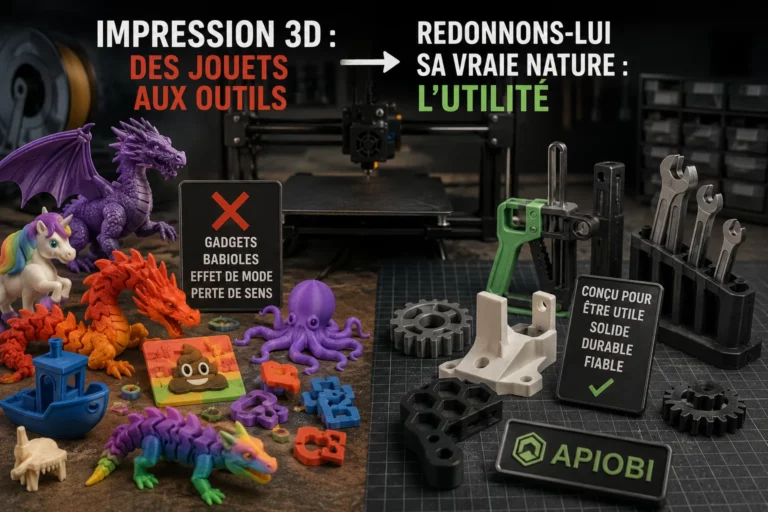
That is precisely what ApiObi is all about. Our goal is not to build the largest catalog, but to publish functional equipment, each model of which has been designed, printed, tested, and validated before being posted online.
This approach naturally leads to publishing fewer new items but many more explanations.
On the other hand, it allows us to devote more time to each development project.
At ApiObi, an STL file is never treated as just a download. It represents the culmination of a design process comparable to that of an industrial product, tailored to the possibilities offered by consumer 3D printing.
Conclusion
The 3D printing ecosystem is currently based on several complementary business models.
Download platforms make files more widely accessible.
Communities promote knowledge sharing.
Designers develop the models.
Users are free to create them however they like.
As 3D-printed objects become fully functional items, the issue of their design is taking on increasing importance, and the value of a model can no longer be judged solely by its price or the number of downloads. It now depends on the quality of the development work that goes into it.
It is this conviction that guides every creation offered by ApiObi: viewing the 3D model not as a mere digital file, but as the result of a comprehensive process of design, prototyping, and validation under real-world conditions.
Platforms thrive on the attention economy.
Designers make their living in the knowledge economy.

 Français
  English
  Español