🚀 Download Platform | 🔒 Secure Payment | ⚙️ 3D Files for Recreational Equipment | 🏆 3D Models Designed for Additive Manufacturing | 2D, 3D, STL, SVG, PDF... | ❤️ Core Values | 💬 Tips, Tricks, and Discussions
ApiObi vs. 3D Download Platforms: Why We Chose a Different Path

Millions of STL files… but how many actual products?
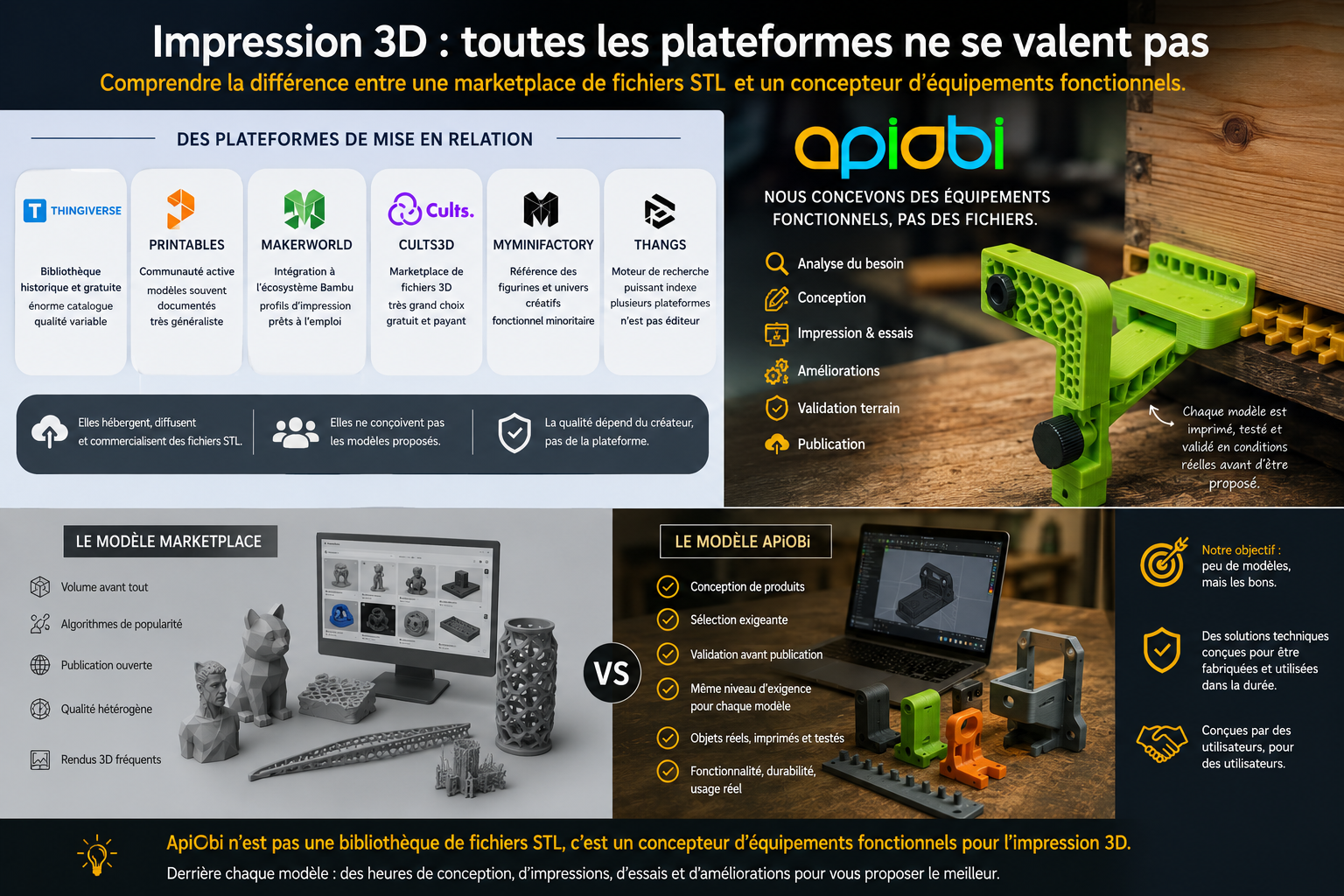
3D printing has never been more accessible. With just a few clicks, anyone can download millions of 3D models from international platforms such as Thingiverse, Printables, MakerWorld, Cults3D, MyMiniFactory, or Thangs.
This abundance is excellent news. It has played a major role in making 3D printing more accessible to everyone and allows everyone to explore this technology.
But this wealth masks a more complex reality.
Today, the vast majority of platforms operate on a simple principle: they connect designers and users. They serve as vast libraries of digital files containing figurines, gadgets, promotional items, decorative objects, prototypes, replacement parts, technical accessories, and sometimes even fully functional equipment.
The best and the worst go hand in hand.
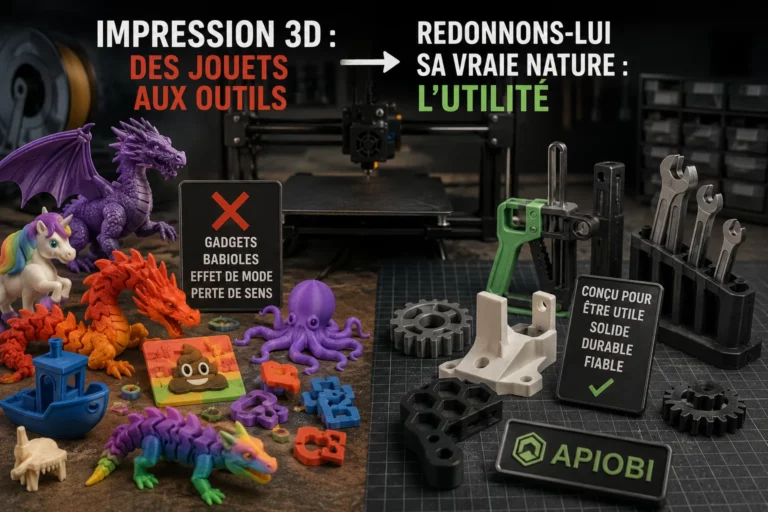
For a user, it can sometimes be difficult to tell the difference between a model that simply looks appealing on a screen and one that is actually designed to be manufactured, used, and built to last.
It was precisely this line of thinking that gave rise to ApiObi’s philosophy.
Understanding the Role of Major Platforms
Before making any comparisons, it is important to note that these platforms fully fulfill the mission they have set for themselves.
Their job is not to design products.
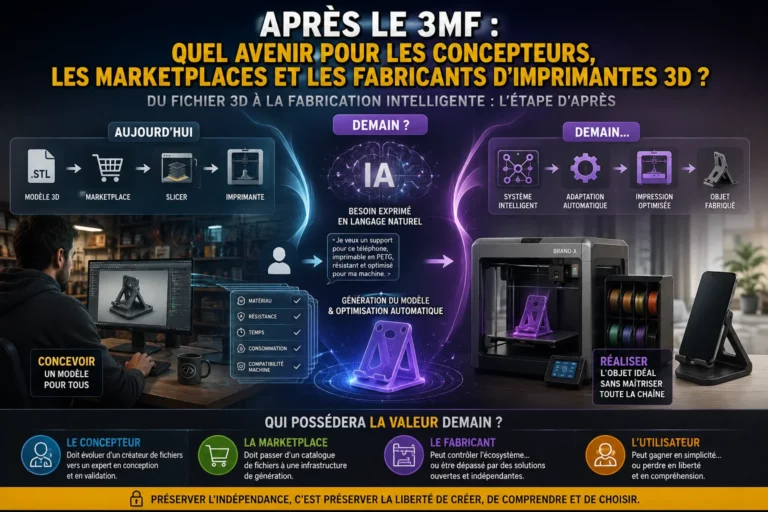
Their business is to provide an infrastructure that allows creators to publish their files and users to download or purchase them. Depending on the case, their business model is based on commissions from sales, subscriptions, advertising, commercial partnerships, or integration into a broader hardware ecosystem.
In other words, these platforms are first and foremost marketplaces specializing in digital files.
This clarification is important because it explains a reality that is often misunderstood: the technical quality of the models offered depends primarily on the designer’s work, not on the platform that distributes them.
The Main Platforms at a Glance
Thingiverse
The historic pioneer in free STL file sharing.
Its vast library is a remarkable resource for learning about 3D printing. It contains millions of models covering every conceivable field.
On the other hand, the quality varies greatly. Many files are old, sometimes abandoned, or have never been updated.
Printables
Developed by Prusa Research, Printables has a very active community and documentation that is often well-maintained.
User feedback makes it easier to identify which models are working properly.
However, the platform remains a general-purpose platform and covers all applications of 3D printing.
MakerWorld
Created by Bambu Lab, MakerWorld is deeply integrated into its printer ecosystem.
In particular, it makes it easier to share print profiles and offers a particularly seamless user experience.
Nevertheless, its catalog remains very broad in scope.
Cults3D
Cults3D is now one of the largest marketplaces for STL files.
Thousands of independent designers sell their designs there.
The platform offers a wide selection.
However, like any marketplace, it does not design the products it sells. Quality therefore depends directly on the reliability of each designer.
MyMiniFactory
The global leader in collectible figurines and universes.
The platform is particularly popular in the areas of role-playing, miniatures, and artistic creation.
Functional equipment remains in the minority there.
Thangs
Thangs stands out primarily for its powerful search engine, which can index models from numerous platforms.
It is more of a search tool than a platform specializing in a particular field.
Popularity does not mean quality
Another common misconception is to equate a model's popularity with its quality.
Platforms naturally highlight the files that generate the most downloads, sales, comments, or interactions.
These indicators measure popularity.
They do not demonstrate that a model was designed using an engineering approach, printed multiple times, or tested under real-world conditions.
Something funny or spectacular can quickly go viral.
Conversely, a technical accessory intended for just a few hundred users will often remain much less visible, despite its impeccable design quality.
Algorithms prioritize visibility.
They are no substitute for expertise.
Just drawing an object isn't enough
Designing truly functional equipment is a craft.
Simply knowing how to use CAD software is not enough to produce a high-performance model.
The designer must also be familiar with additive manufacturing processes, material properties, mechanical stresses, printing technologies, slicers, assembly tolerances, and the actual conditions under which the object will be used.
Above all, he needs to devote time to prototyping.
Print.
Test.
Edit.
Reprint.
Try again.
Sometimes dozens of times.
However, there is currently no rule requiring that a model published on a platform have actually been printed, used, or validated before it is posted online.
Some platforms encourage users to submit documentation or feedback. While these efforts are helpful, they do not constitute a systematic validation of every model.
Why ApiObi Exists
ApiObi was born out of a simple observation. We didn't want to create a new library of STL files. We wanted to create a catalog of functional components.
That subtle difference changes everything.
At ApiObi, a model is never released simply because it looks good.
It is published because it solves a problem.
Because it simplifies a task.
Because it replaces an existing product.
Because it makes a real difference.
We have deliberately chosen to specialize in the following areas: functional 3D printing, repairs, outdoor activities, sport fishing, beekeeping, DIY, and technical equipment.
Our goal is not to offer thousands of models.
Our goal is to publish only those products that we ourselves would be the first to use.
Our business is to design
ApiObi is not an open platform where anyone can freely publish their creations.
ApiObi is, first and foremost, a designer.
Each model follows the same process:
- needs analysis; ;
- performance targets; ;
- DFAM design; ;
- prototyping; ;
- tests; ;
- iterations
- validation under actual operating conditions; ;
- publication…or not
This method takes time. A lot of time.
But that’s also what allows us to offer models whose strengths—and limitations—we truly understand.
Two Perspectives on 3D Printing
| General-purpose platforms | ApiObi |
|---|---|
| STL File Marketplace | Functional Equipment Designer |
| Open Publication | Curated Catalog |
| A very large selection of models | A Deliberately Limited Selection |
| All categories | Professional Specialization |
| Algorithm-Driven Popularity | Publication after field validation |
| Quality depends on each creator | The same high standards apply to every model |
| Digital Library | Product Development |
In conclusion
Major international platforms have played a significant role in raising awareness of 3D printing and are valuable resources for learning about this technology, experimenting with it, or printing hobby projects.
ApiObi isn't trying to replace them. We're in a different line of business.
We design functional devices intended to be manufactured using a 3D printer.
Behind every model we release are hours of brainstorming, design, prototyping, printing, testing, and refinement. Our catalog is intentionally limited, because we prefer to release only a few models—but to release them only when we believe they truly meet the need for which they were designed.
At ApiObi, an STL file is never an end in itself. It is the result of a process of design, testing, and validation.
We do not sell a collection of files.
We share technical solutions designed to be manufactured, used, and maintained.

 Français
  English
  Español