
⛓️💥 Independent platform | 🚀 Ultra-fast downloads | 🔒 Secure payment | 🏆 PREMIUM 3D models | ⚙️ Functional equipment | 📉 Low prices | ❤️ Strong values | 💬 Tips, tricks, and discussions
Why a functional 3D model sometimes costs more than an equivalent manufactured product

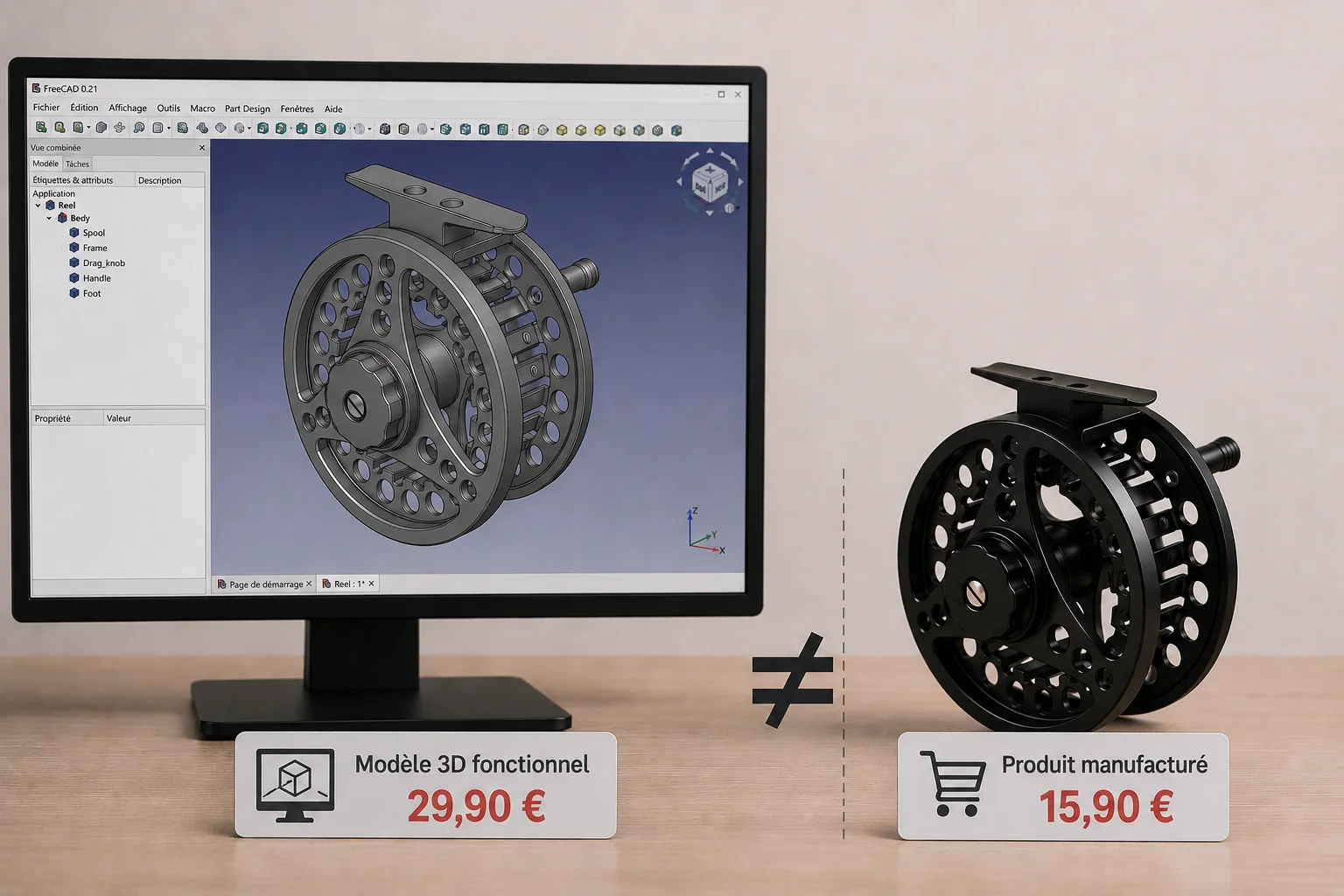
In the world of 3D printing, many consumers wonder: why is a simple STL file of a tool or functional accessory sometimes priced close to—or even higher than—the physical product available in stores? This perception is based on a misconception. A functional 3D model is not just a digital file, but the result of in-depth design work, technical expertise, and a range of costs that are often invisible to the end user.
1. Design is engineering work, not just downloading
Designing a reliable, functional tool requires genuine engineering expertise. It involves many hours of modeling, optimization phases, and several rounds of iteration. Unlike a purely decorative object, a model intended for real-world use must meet specific mechanical, ergonomic, and functional requirements. This process demands advanced product design skills. The price of the file therefore reflects both the time invested and the level of expertise required.
2. Testing, prototypes, and materials… all of that comes at a cost
Before a functional 3D model is put up for sale, it is typically printed multiple times to ensure it meets specifications. The designer must test different configurations, adjust tolerances, verify strength and ergonomics, and refine the part’s performance under real-world conditions. Each iteration involves material consumption, machine time, and the use of equipment. These costs, although not immediately apparent to the user, are factored into the final price of the model.
3. The 3D model replaces the final product—not its value
Purchasing a 3D file grants access to a complete product, which the user can print themselves as many times as needed for personal use. This is not the purchase of a single object, but rather access to the ability to reproduce it. In this context, the designer no longer sells a physical unit, but rather a usage right allowing for the unlimited production of the product. The price of the file must therefore reflect this economic model, which differs from that of a traditional manufactured product.
4. The prices of manufactured goods no longer always reflect their true value
Another source of confusion stems from the proliferation of online shopping platforms offering manufactured goods at extremely low prices. Many consumers have gradually gotten into the habit of comparing an item’s value to its listed price on these sites, without always considering the fundamental differences between a mass-produced industrial product and a 3D-printed model designed by an independent creator.
When an accessory is produced in tens or hundreds of thousands of units in a highly automated factory, the costs of design, development, tooling, and manufacturing are spread across a large volume. This economy of scale allows for extremely low unit prices, sometimes lower than the cost of producing a single 3D-printed part.
Added to this are economic realities that are often invisible to the buyer: lower labor costs, offshored production, very low margins on certain loss leaders, local subsidies in certain countries, or even business strategies aimed at driving traffic rather than truly adding value to the product being sold.
This situation sometimes creates a misleading perception of value. When a mass-produced accessory is offered for a few euros on an international platform, it becomes tempting to assume that an STL file sold at the same price would be too expensive. However, the comparison is not valid. On one hand, there is a product manufactured industrially on a very large scale; on the other, an original design created by an individual or a small team, often after dozens of hours of development, prototyping, and testing.
Comparing prices alone ultimately amounts to comparing two radically different business models. The real question is not how much the mass-produced item costs, but what value is represented by the design that enabled its creation and improvement. In the field of functional 3D models, it is precisely this expertise, this development time, and this capacity for innovation that constitute the bulk of the value offered to the user.
5. Protection, Plagiarism, and Liability: An Ongoing Risk
The designer of a functional 3D model operates in an environment exposed to numerous risks, including file theft, unauthorized reproduction, and illegal distribution on third-party platforms. Added to this is the issue of misuse or inappropriate use of models, which can result in legal liability. Pricing strategy thus plays a role in recognizing the work done and ensuring the economic viability of the business in a context where copying is technically easy.
6. What the customer ultimately gains
Purchasing a high-quality 3D model provides access to an optimized product that has been tested and designed to be truly functional. It reduces the risk of print failures, minimizes material waste, and ensures that the product performs as expected. Users thus benefit from a proven design, built to last and to meet a specific need. Beyond the file itself, it provides access to a reliable technical solution that can be reproduced as often as needed.
Conclusion: There is much more to an STL file than just an STL file
When evaluating the price of a functional 3D model, it is important to understand what you are actually paying for.
Customers aren’t buying a few megabytes of digital data. Nor are they buying a few grams of virtual plastic to be processed by their 3D printer. What they are buying, above all, is the result of a design process that can sometimes take several weeks or even several months.
Behind every functional model lie hours of observation, reflection, technical drawing, prototyping, printing, testing, revisions, and validation. You have to understand the need, envision a solution, master the constraints of additive manufacturing, know the limits of the materials, anticipate printing difficulties, and, above all, verify that the object actually fulfills its purpose once it comes out of the printer.
It is precisely this philosophy that guides Apiobi.
At Apiobi, a model is never published simply because it looks good or because it displays correctly in a 3D viewer. A model is published because it was designed to solve a specific problem, physically manufactured using a 3D printer, tested under real-world conditions, and proven effective enough to be worth sharing.
This approach takes time. A lot of time.
It also involves accepting dozens of test prints, failures, and changes—sometimes minor but crucial—as well as field testing when the item is intended for outdoor, athletic, or technical use.
The goal is not to offer as many files as possible. The goal is to offer templates that users can reasonably expect to work once printed.
This is also why Apiobi fully stands behind the positioning of its designs. When a model is posted online, the asking price does not cover non-existent materials or printing time that will be handled by the user. It covers the design, accumulated experience, testing, and expertise required to transform an idea into a truly usable object.
In a world where platforms are flooded with unverified files, appealing concepts that never make it to print, and templates designed to attract downloads rather than meet a real need, Apiobi takes a different approach.
An approach grounded in facts, objects, field tests, and a simple conviction:
A good 3D model isn't measured by the number of polygons it contains, much less by the number of likes it gets, but by its ability to consistently fulfill the purpose for which it was designed.
It is this value that Apiobi users choose when they download a model. Not plastic. Not a file. But the experience, time, and dedication that made this model possible.
I thank them for that.
M@t - ApiObi


 Français
  English
  Español