🚀 Download Platform | 🔒 Secure Payment | ⚙️ 3D Files for Recreational Equipment | 🏆 3D Models Designed for Additive Manufacturing | 2D, 3D, STL, SVG, PDF... | ❤️ Core Values | 💬 Tips, Tricks, and Discussions
3D printing tips, fact or fiction?

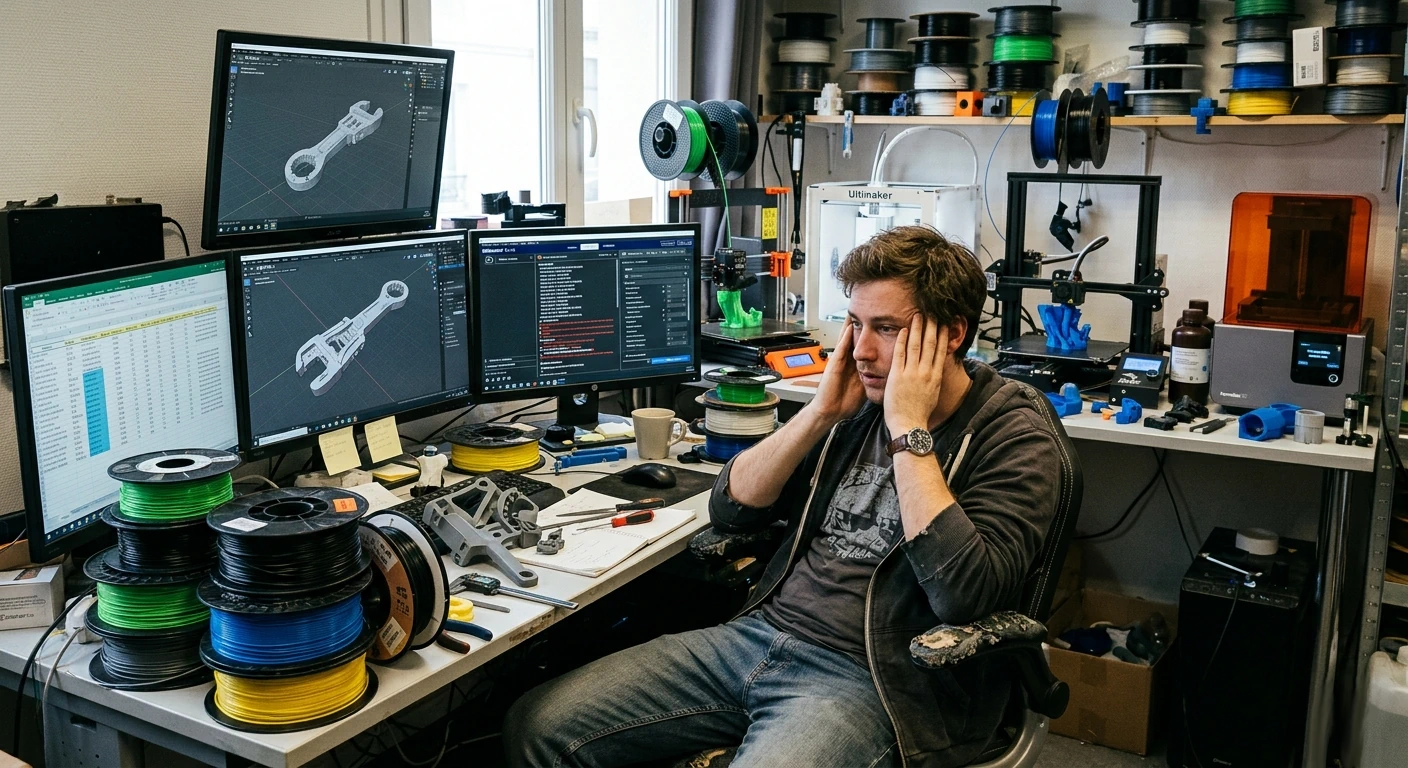
The success of 3D printing depends not only on the quality of the file or the design: it also depends on three fundamental and closely related variables: the machine used, the slicer and the printing material.
For a serious designer, this reality imposes a fundamental reflection: no 3D file can be universally ready for use in all possible combinations, understanding why is essential for anyone wishing to create or use reliable functional models.
1. The diversity of 3D printers
The market for FDM and resin printers is vast and constantly evolving. From domestic and semi-professional models to specialized industrial machines, there are hundreds of significant models, with new generations appearing every year.
Each printer has its own characteristics: precision, print volume, mechanical tolerances, maximum temperature, type of platen, and built-in calibration systems. These differences can turn the printing of a carefully designed model into a failure if they are not anticipated.
So it's an illusion to think that a designer can know every machine on the market. What he must do, however, is gain empirical experience of the main technologies (FDM, resin, etc.) and representative machines, to predict and adapt its models to realistic situations.
2. The variety of slicers
The slicer plays a central role in the 3D printing workflow. It converts a 3D model into printer instructions, These include trajectories, supports, filling and thermal parameters.
The most commonly used slicers include Cura, PrusaSlicer, Slic3r, IdeaMaker, Simplify3D, MatterControl, and many others. Each has its own algorithms and multiple parameterizable options.
This diversity makes impossible total control of all slicers and their settings. What distinguishes a professional designer is the ability to understand general principles, to empirically test and validate his models, and to document parameters to offer users the best chance of success.
3. Diversity of materials
The choice of material is just as decisive. PLA and PETG are widely used, but functional designers also use :
- Nylon and its reinforced variants; ;
- Carbon-fiber or glass-fiber composites; ;
- TPU and other elastomers; ;
- High-temperature engineering filaments (PEEK, ULTEM™); ;
- Filaments certified for food contact.
Each material has unique mechanical and thermal properties: adhesion to the platen, print speed, shrinkage, resistance to wear or mechanical stress. A part that prints perfectly with one material may already fail with the same material from another brand, and of course with another if it hasn't been designed for that specific material.
4. The Arrival of Enhanced 3MF Files: Between Simplification and Technological Dependence
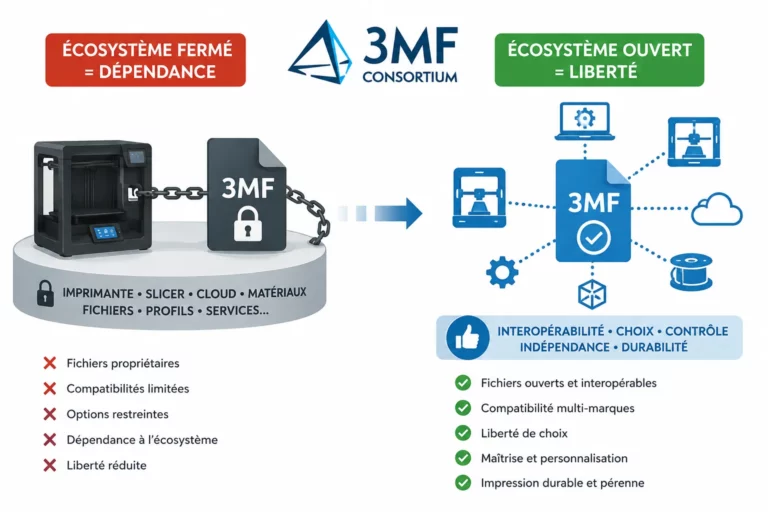
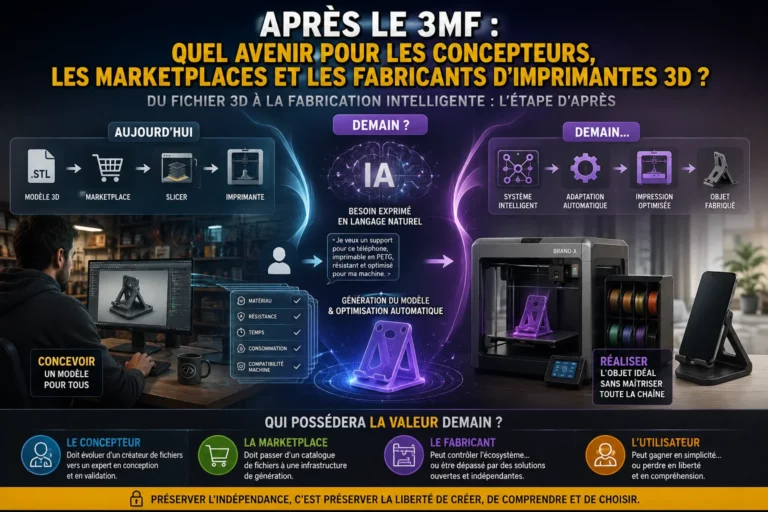
In recent years, some platforms have prioritized file sharing 3MF containing not only the 3D model, but also a large portion of the print settings: part orientation, material profiles, colors, supports, layer height, and even settings specific to a particular printer brand or slicer.
For novice users, this approach has a clear advantage: often, all you need to do is open the file to start printing, with very few settings to adjust.
However, this simplicity comes at a cost.
By incorporating settings optimized for a specific environment, certain files become closely tied to a particular hardware and software ecosystem. Users are then naturally inclined to use the printer, slicer, and sometimes even the consumables from the manufacturer that designed that environment. This approach can limit interoperability, which has nevertheless contributed significantly to the development of consumer 3D printing.
At ApiObi, we take a different approach. We don’t design models for a specific printer brand. We design equipment for users. That’s why we prioritize STL files, which give everyone the freedom to choose their own printer, slicer, and materials, while maintaining true technological neutrality.
5. Multicolor printing: a spectacular advancement… but not always practical
The rise of enriched 3MF files goes hand in hand with another major development in 3D printing: the widespread adoption of multicolor printing.
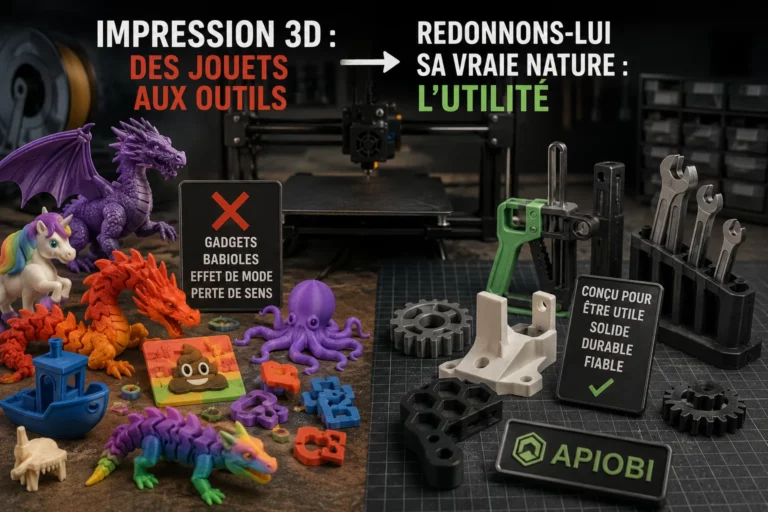
The demonstrations offered by manufacturers are often impressive. Figurines, articulated objects, gadgets, decorations, and custom accessories are now printed automatically in multiple colors, sometimes without any user intervention. This development meets a very real demand and helps make 3D printing more accessible to an ever-wider audience.
However, in the field of functional 3D printing, the issue is quite different.
A tool holder, a fishing accessory, beekeeping equipment, or a mechanical part does not become any stronger or more durable simply because it is printed in four colors. The key factors remain the quality of the design, the choice of material, dimensional accuracy, and control over the printing parameters.
In fact, the true value of multi-material printing is rarely highlighted. Yet it opens up some particularly interesting technical possibilities: printing with soluble materials, combining rigid and flexible materials in a single part, creating non-slip or shock-absorbing areas, or combining materials with complementary mechanical properties.
These applications are more about engineering than aesthetics.
At ApiObi, we certainly don’t rule out multicolor printing when it meets a real need. Color can improve the visibility of a marking, enhance safety during use, or make it easier to assemble equipment.
However, we reject the idea that it should be the sole criterion for quality.
Our priority remains the same: to design equipment that is reliable, durable, and truly usable. Color is just one feature among many; it is never a substitute for rigorous design.
5. A skill set that is at risk of disappearing
3D printing has developed around a “maker” culture: understanding your printer, learning how to configure your slicer, experimenting with materials, and improving with each print. Fully preconfigured 3MF files are gradually changing this approach.
When all the settings have already been configured by the designer or manufacturer, users print more… but sometimes understand less of what they’re printing. In the short term, this automation often improves the success rate.
In the long run, however, it can hinder the development of the skills needed to troubleshoot a printing problem, adapt a model to a different machine, or choose the material that is truly suitable for a specific application.
In other words, the more decisions an ecosystem makes on the user’s behalf, the more autonomy the user loses.
At ApiObi, we believe that the success of a print job should not depend on a closed environment, but rather on a gradual understanding of the mechanisms that make it possible.
6. An equation that has become impossible to solve
Designing a truly universal 3D model has become an increasingly complex task.
In addition to the traditional components—printers, slicers, and materials—we now have increasingly integrated software environments, manufacturer-specific print profiles, multicolor printing systems, and enriched 3MF files that can embed parameters specific to a particular ecosystem.
Add to that the extremely rapid pace of innovation, and the equation becomes virtually impossible to solve. Every year, new printers, new extruders, new materials, new slicers, new print profiles, and new automation features emerge, changing design and printing practices.
Under these circumstances, no designer can claim to be familiar with every printer on the market, to be proficient with every slicer, to have tested every brand of filament, or to have validated every possible combination. Their job now is to understand the fundamental principles of 3D printing in order to design models capable of functioning in as many environments as possible.
That is precisely why, in the printing guidelines that come with each ApiObi model, I never specify a universal temperature, speed, or setting.
The extrusion temperature does not depend solely on the material. It also depends on the material’s formulation, manufacturer, moisture content, actual filament diameter, the printer used, the type of nozzle, the slicer, print speed, extrusion rate, cooling, machine calibration, and even ambient conditions.
The same applies to print speed, which is always the result of a trade-off between the part’s geometry, the machine’s mechanical capabilities, the material used, and the desired level of quality.
Providing a single value would therefore be inaccurate, misleading, and contrary to the rigorous approach I aim to apply to each of my models.
8. Conclusion: Expertise, Rigor, and Empirical Testing
Designing functional 3D models requires, above all, a thorough understanding—and, better yet, true expertise—in the field of application for the product being designed. Anyone designing equipment intended for everyday use must be its first and most demanding user. A good designer is, above all, a practical person who faces real-world constraints, rather than an all-knowing oracle in a laboratory.
This process then requires:
- hands-on experience with printing machines and the main printing technologies; ;
- a thorough understanding of slicers and their settings (not to mention computer-aided design software, which will be the subject of a future article); ;
- technical expertise in materials and their behavior during printing.
It is this combination of skills that makes it possible to design models that are truly reliable, durable, and reproducible. A functional 3D file is not just a digital object to download: it is the result of a thorough process of design, prototyping, testing, successive improvements, and validation under real-world conditions.
Today, a designer’s expertise is no longer measured by the number of printers they know or the number of print profiles they have mastered. It is measured by their ability to design models robust enough to adapt to the diversity of machines, slicers, materials, and technological advancements. Designing a truly interoperable model has become an engineering discipline in its own right.
Understanding this diversity allows us to put responsibility, methodology, and technical standards back at the heart of 3D printing, far removed from approximations, supposedly universal settings, and the false notion of “free” services that still circulate far too often on the Internet.
At ApiObi, we don't design models for a printer brand. We design equipment for users. Technology neutrality is not a marketing choice: it is an essential requirement for ensuring the sustainability, interoperability, and freedom of use of our models.

 Français
  English
  Español