
🚀 Download Platform | 🔒 Secure Payment | ⚙️ 3D Files for Recreational Equipment | 🏆 3D Models Designed for Additive Manufacturing | 2D, 3D, STL, SVG, PDF... | ❤️ Core Values | 💬 Tips, Tricks, and Discussions
3D printer, from toy to autonomous production workshop

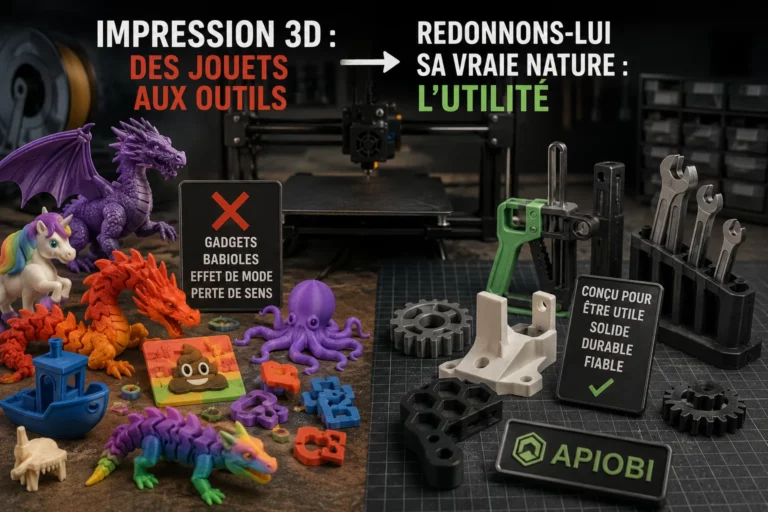
3D printing is too often reduced to the manufacture of playful gadgets, key rings, figurines or decorative parts in PLA - objects with no real mechanical constraints. This limited vision masks a more powerful reality: a properly operated 3D printer can produce parts that are functional, durable and technically comparable to those produced industrially.
This is true not only in the home but also in demanding industries such as aerospace, automotive, and luxury goods.
How does 3D printing evolve from a hobby object to a useful tool?
How do you choose the right materials, and why does this approach turn the 3D printer - not into a toy - but into a personal workshop?
📌 1. The consumer 3D printer: a technical tool, not a gadget
Today, a modern consumer 3D printer can produce parts :
- solids - adapted to real-life mechanical constraints; ;
- sustainable - resistant to impact, water and bending; ;
- personalized - designed for specific use.
This potential depends not only on the machine, but above all on 3D files and end-use design, a principle known in engineering as Design for Additive Manufacturing (DFAM).
🧰 2. 3D design: the basis of a functional part
A well-printed part is more than just a shape: it has to be designed with the customer in mind. according to the physical constraints it will undergo. This implies :
- from consistent thicknesses ;
- from reinforced zones (ribs, reinforcements) ;
- from optimized printing orientations ;
- a customized infill to the targeted mechanical stress.
A simple PLA figurine doesn't have these requirements. A wrench, a hook or a tool must be analysed as a "key". technical components, with mechanical properties taken into account right from the design stage.
🧬 3. Technical materials: from PETG to high-performance polymers
To move from playful to functional use, the choice of material is decisive.
🔹 PETG: the gateway to functionality
The PETG (Polyethylene Terephthalate Glycol) is a polymer whose characteristics are similar to those of industrially-used PET.
He presents:
- good shock resistance; ;
- a certain elasticity; ;
- greater tolerance to humidity than PLA.
👉 A fishing accessory or mounting bracket in Well-designed PETG can be compared in every respect to an industrial PET accessory, in terms of mechanical strength and environmental resistance.
🔹 Nylon and carbon fiber composites
For even more mechanically resistant parts, carbon fiber (CF)-reinforced nylon (PA) is a proven solution.
According to specialized guides, these composites :
- offer a excellent tensile strength ;
- better withstand repeated loads; ;
- are suitable for active mechanical parts (gears, pivots, axes).
👉 This is a category of materials used in the automotive and robotics industries for components subjected to real-world loads. Did you know that a nylon nut (non-CF) costs more than a metal one? You probably doubt it… so stop by your local hardware store and see for yourself!
🔹 High-performance polymers (PEEK, ULTEM)
In critical industrial applications, thermoplastics such as PEEK or the’ULTEM™ are used for :
- withstand high temperatures; ;
- maintain a high level of structural strength ;
- withstand demanding mechanical environments.
These polymers are now standard in the aerospace and defense industries.
⚠️ Important note These high-performance materials require 3D printers equipped with high-temperature extruders and highly stable heating platens - often professional models that are much more expensive than consumer printers.
✈️ 4. When industry uses 3D printing for final production
The technical truth goes beyond the prototype. Here are some concrete examples where additive printing is a recognized means of production :
🛫 Aeronautics
Manufacturers such as GE Aviation use metal printing to produce turbine parts. These components are not only functional, but certified for in-service use, with gains in performance and durability.
Source : Investopedia - 3D printing overview
🚗 Automotive
High-end manufacturers are integrating parts printed in technical polymers or composites to reduce weight, improve performance or customize components on demand.
Source: Ricoh 3D - Additive manufacturing in the automotive industry
⌚ Luxury / High Tech
Even in consumer tech, components such as titanium watch frames are now produced by 3D printing, exploiting the material's advantages (light, strong) at industrial level.
Source: Tom's Hardware - Apple and titanium printing
🎯 5. From provocative scenario to functional reality
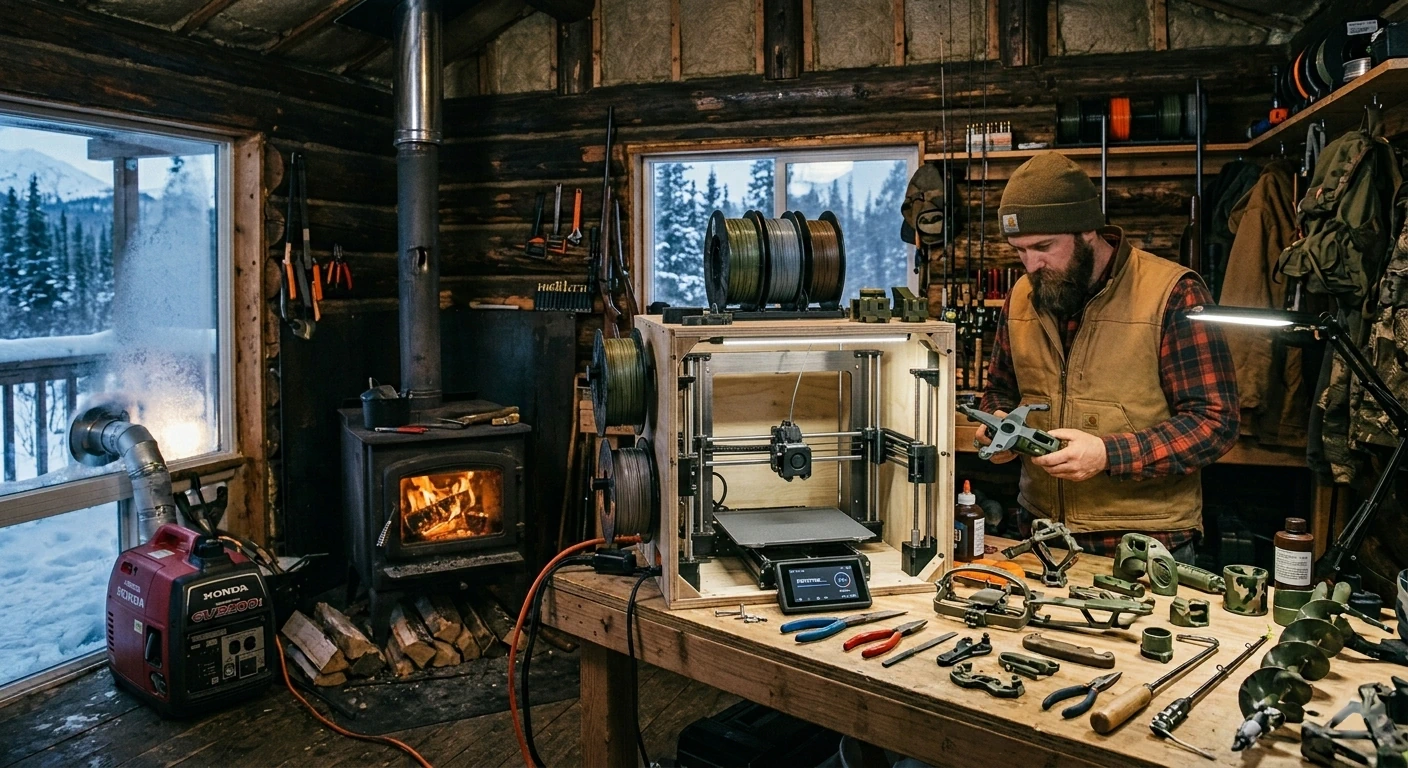
Imagine a survivalist isolated deep in Alaska with a 3D printer powered by a generator. Instead of carrying dozens of tools, he could produce :
- fishing accessories, floats, trap structures, special lures ;
- hunting accessories, arrowheads, blowpipes and darts, traps ;
- repair parts or axles for mechanisms ;
- custom-made jigs, clamps, turnbuckles ;
- parts that can't be found without a long journey.
This vision may seem provocative, but it illustrates a truth: 3D printing is a local, flexible and adaptable means of production, which transforms a domestic machine into a high-performance, self-contained workshop...
📌 Conclusion: 3D printing is not a distraction - it's a production tool and autonomy
At Apiobi, we don't just dream; we create, test and validate. solutions that work in real life. Every 3D model we design is imagined not to be admired on a screen, nor to become just another gadget tucked away at the bottom of a drawer. to be printed, used, abused, improved and finally adopted by those who need it. This rigorous, iterative approach, rooted in real experience, sets us apart from much of what is circulating today on sharing platforms. a concrete response to a tangible problem.
This vision is not limited to the simple creation of digital files. It is part of a logic of’responsible and sustainable innovation, 3D printing becomes a production tool in its own right - capable of generating functional, robust parts, equivalent or even superior to those produced industrially for certain uses. It links technical requirements, knowledge of materials, real-life constraints and the autonomy of the maker or everyday user.
By putting utility first, by thinking each model in terms of how it will be used, and by validating each prototype in the real conditions in which it will be used, Apiobi does more than just design: we're reinventing the way enthusiasts and curious users embrace 3D printing to make it a sustainable, relevant and fully integrated tool for everyday life.
Our commitment is clear: to offer solutions that are tested, reliable and effective. nothing less.
🔧 An approach that's accepted, asserted... and embodied.
And if I'm talking about this necessary evolution of 3D printing - from decorative hobby to technical tool - it's because I live it every day.
As a 3D designer and founder of Apiobi, I see every day what 3D printing can really achieve when we stop confining it to “fun” PLA and interchangeable trinkets. I see the huge, tangible, immediate potential: useful tools, reliable accessories, parts that you actually use. Objects that have a reason to exist.
This conviction comes neither from marketing posturing nor from fashion. It's the result of hundreds of hours of design, testing and prototypes that have been put through the mill of real-world use.
It's a practice, not a theory.
And it's this practice that guides everything I publish, everything I design, everything I share.
🌱 Why this approach deserves to exist - and be defended
Because a 3D printer can be much more than a machine for printing goodies.
Because it allows us to produce locally, to repair rather than replace, to create rather than passively consume.
Because it gives private individuals a manufacturing power that was once reserved for industrial workshops.
And above all: because it opens up a space where common sense, ingenuity and technical rigor take their place again, The result is a new, easy-to-use tool, far removed from the endless stream of gadget files whose usefulness is sometimes hard to measure.
🎯 A discreet but assertive call...
I don't need to explain why Apiobi exists: the article you just read is proof enough.
If I design and share models, if I document, if I write and if I publish, it's to contribute to this transformation:
bring 3D printing to what it can really be - a powerful, functional and useful ally able to offer solutions that really help.

 Français
  English
  Español