
🚀 Download Platform | 🔒 Secure Payment | ⚙️ 3D Files for Recreational Equipment | 🏆 3D Models Designed for Additive Manufacturing | 2D, 3D, STL, SVG, PDF... | ❤️ Core Values | 💬 Tips, Tricks, and Discussions
Asian hornet traps: quality warning

Prospective buyers—whether individuals or professionals—would be well advised to do their research before purchasing trap kits, inquiring about the materials used and the seller’s knowledge of the Asian hornet, bees, and the products they sell to combat this pest.
With access to a 3D printer, many unscrupulous individuals have sensed an opportunity and are selling batches of «new» traps at unbeatable prices on online marketplaces such as Leboncoin, Etsy, and eBay. And for good reason: neither designers, nor professionals, nor users—and certainly not beekeepers—who have sometimes never even seen a single yellow-legged hornet in the wild, they’ve simply downloaded free 3D trap design files from the internet—which, incidentally, they often aren’t even allowed to sell! (In most cases, free 3D files are available only on the obvious condition that they be used exclusively for personal and private purposes—and certainly not for business!)
Before buying, «have some fun» by asking them about the design and effectiveness tests conducted on these traps, or about their design expertise, their knowledge of hornets, beekeeping, the size of the entry and exit openings, and so on. Are they designers? Manufacturers? Resellers? Beekeepers? These are all questions and answers rarely addressed in the ad copy.
Provided they agree to answer you (honestly), you’ll sometimes be surprised by their responses—and also to discover that these traps are most often made of a fragile, biodegradable plastic that’s completely unsuitable for outdoor use (PLA filament, polylactic acid made from cornstarch), but they are very easy to print and inexpensive. Parts produced using this plastic have a very high-quality finish, similar to that of a manufactured product.
Worse still, trap grids made from this material are so fragile that they cannot withstand—or barely withstand—installation, even the slightest impact, or—even more worryingly—the mandibles of trapped Asian hornets that are far from pleased with their fate. In any case, a poorly designed trap will have other structural flaws even if it is made from more durable plastics such as PE or ABS.
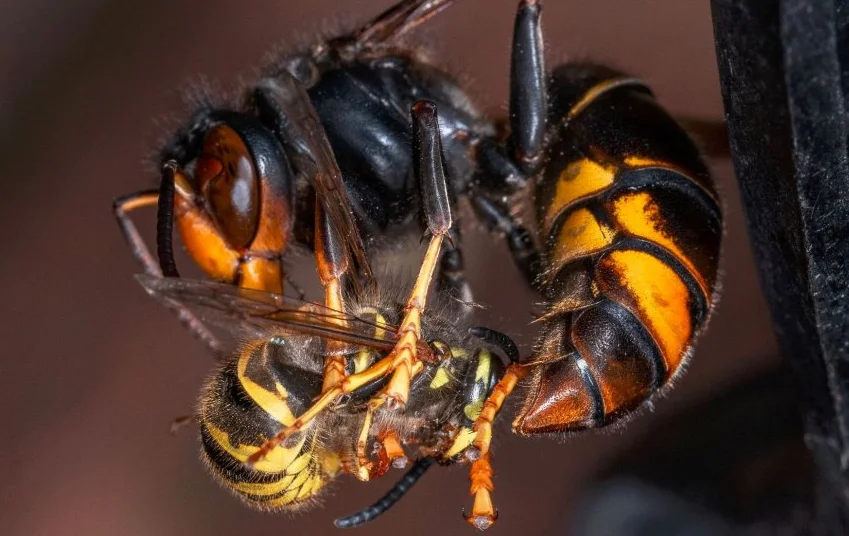
Asian hornets trapped in a trap remain alive for several days, devouring other captured insects, such as this wasp. They show no discrimination; their weakened or smaller counterparts are also part of the feast. The aggressiveness and energy they display in doing everything they can to survive and return to their colony are exceptional and, it must be said, command admiration.
Before making a purchase, always be wary of listings that lack photos showing the trap set up in the wild, near an apiary, with hornets inside. If you ask for them and the seller is unable to provide them, it’s best to walk away. AI may work wonders, but it’s not advanced enough to fool a keen eye.
Finally, many of these traps are poor, illegal copies of designs protected by intellectual property rights, which took their designers months to create (I know what I’m talking about—I’ve learned this the hard way…)
Shoppers who buy discount traps, thinking they’re doing their part to combat the Asian hornet, are being duped. Meanwhile, these winged predators remain free as a bird.
Finally, and without meaning to scare you, you should know that an Asian hornet is a true flying demon, capable of hovering 1.5 meters above the ground before attacking its victim repeatedly. I’ve been stung before while weeding my orchard, and I can attest to its aggression and relentless nature for no apparent reason. The pain from the multiple stings it inflicted on me is indescribable. If it manages to escape from a trap that’s not designed to catch it, it will be in a very, very bad, venomous mood and take out its frustration as soon as it’s free.
“If you see a beekeeper running, run without thinking.” An old beekeeping saying
In conclusion
Buy your traps from professionals who work hard every day and pay high operating costs—from designers and manufacturers who know what they're doing.
And also to beekeepers, because YES, you have to be a beekeeper to understand and combat the Vespa velutina, to trap it selectively—because it’s entirely possible—and to do so with all the necessary precautions.
Why not pay a visit to a beekeeper near you? He’ll give you excellent advice and will be delighted if you help with trapping founder queens at the start of the season, for example. In doing so, you’ll not only protect his bees, of course, but also safeguard the population from this invasive, uncontrollable, and deadly spread.
A thousand thanks to you for standing up for bees and intellectual property.

 Français
 English
 Español