
🚀 Download Platform | 🔒 Secure Payment | ⚙️ 3D Files for Recreational Equipment | 🏆 3D Models Designed for Additive Manufacturing | 2D, 3D, STL, SVG, PDF... | ❤️ Core Values | 💬 Tips, Tricks, and Discussions
Why Articulated Models and Other PLA Trinkets Have Ruined the Image of 3D Printing

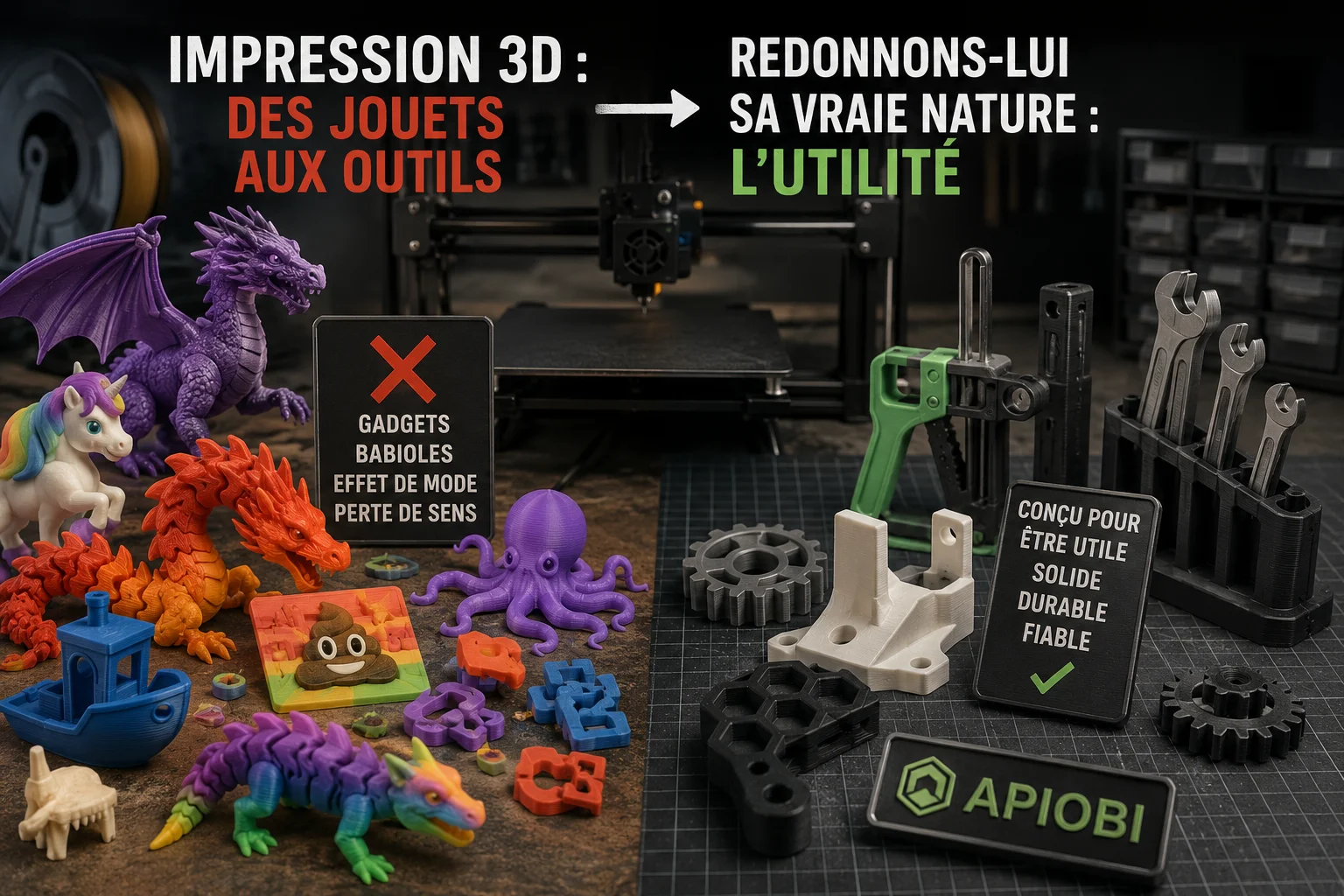
Introduction
3D printing has seen explosive growth in popularity. The number of home printer owners is growing, free file-sharing platforms are booming, and social media is overflowing with videos showcasing “spectacular” objects: articulated dragons, mechanical animals, colorful figurines, and fun gadgets.
A massive success… but not without consequences.
This flood of entertaining models has gradually reduced the perception of 3D printing to that of a mere hobby, completely overshadowing its functional, technical, and mechanical potential. Yet 3D printing is a major industrial tool, used in critical sectors such as aerospace, healthcare, the automotive industry, and the production of specialized tools.
This article explains how articulated toys have diverted the general public’s attention… and why it’s essential to put 3D printing back in its proper place: that of a powerful, sustainable, and useful standalone production tool.
1. A flood of gadgets that distorts public perception
The Virality of “Spectacular” Objects”
Free 3D file-sharing platforms foster an economy based on visibility: the more visually impressive an object is, the more it is downloaded and shared.
Articulated dragons, flexible snakes, and mechanical figurines check all the boxes:
- easy to print,
- very photogenic, with a finish similar to that of a manufactured product
- perfect for social media,
- often printable quickly, in a matter of minutes to a few hours.
A direct consequence: 3D printing is mistaken for an idle pastime
The general public reduces technology to this:
«A machine for printing toys.»
This perception completely obscures:
- mechanical design,
- materials engineering,
- functional optimization,
- technical and professional applications.
2. PLA: an attractive material… but one that gives a bad impression
Why PLA Dominates 3D-Printed Toys
Articulated gadgets are almost always printed in PLA because it is:
- a flagship product for manufacturers,
- available in a wide variety of colors and styles,
- easy to print,
- not very demanding,
- very attractive,
- marketed as “organic” or “eco-friendly.”.
The problem: PLA is damaging the technology's reputation
PLA is also:
- fragile,
- brittle,
- permeable to ambient moisture,
- unstable depending on temperature, humidity,
- unsuitable for mechanical stresses,
- not cheaper than other materials
Consequence:
The public thinks that “3D printing breaks things.”.
The problem, however, is not the technology itself, but the inappropriate use of a decorative material for functional purposes.
3. “Printing a dragon” has nothing to do with designing a functional part
No technical expertise required
Printing an articulated dragon requires:
- no control over constraints,
- no discussion of resistance,
- no mechanical testing,
- no knowledge of technical materials.
but artistic design skills and undeniable talent.
On the other hand, designing a functional room requires:
- an assessment of the terms of use
- a discussion of the constraints,
- tolerances tailored to the machines and filament types,
- an optimized print orientation,
- consistent thicknesses,
- adaptation to the material used.
That's where the expertise of a professional designer comes in.
4. Unrealistic expectations created by a culture obsessed with gadgets
Toys have instilled in the public’s mind the idea that a coin:
- is easy to print,
- costs a few euro cents,
- works right away,
- does not require domain-specific knowledge
- does not require a specific design,
- must be made of PLA.
This view is completely out of touch with the reality of functional 3D printing—and of 3D printing in general.
The Technical Truth
A functional room requires:
- Skills and business expertise,
- design,
- tests,
- iterations,
- technical materials,
- usability tests,
- Demanding use under real-world conditions,
- and then, only after approval… or not
In short, it's a product design project.
5. 3D printing must regain its status as a true production tool
3D printing isn't limited to action figures. It allows you to:
- sustainable repair,
- the manufacture of hard-to-find parts,
- the development of specialized tools,
- improvements to everyday equipment,
- the production of durable, custom-made accessories.
But this value can only emerge if:
- The design is meticulous,
- the materials are suitable,
- the process is under control,
- The object is designed for real-world use.
Conclusion
The popularity of PLA-printed gadgets has clouded people’s understanding of what 3D printing is actually capable of. It has fostered a narrow, playful, and sometimes childish view of a technology that is, in fact, used to produce critical parts in demanding professional environments.
PLA is a great filament, perfectly suited for certain projects. Just because it’s easy to use doesn’t mean it’s a universal material that’s supposedly suitable for all projects.
It's time to correct that perception.
3D printing isn't (just) a hobby.
A 3D printer is a “workshop”—a true autonomous manufacturing tool.
A hinged model requires a printer.
A functional tool requires a designer—regardless of what developers of automated features might say, who lead users to believe that a slicer can make structural changes to a part blindly, regardless of the material used. No, neither a printer nor a slicer understands the purpose of a part; they simply interpret a mesh.


 Français
  English
  Español