🚀 Download Platform | 🔒 Secure Payment | ⚙️ 3D Files for Recreational Equipment | 🏆 3D Models Designed for Additive Manufacturing | 2D, 3D, STL, SVG, PDF... | ❤️ Core Values | 💬 Tips, Tricks, and Discussions
Why can 3MF files and «turnkey» ecosystems make makers dependent on their printers?

Introduction
Just a few years ago, using an FDM 3D printer generally required at least a basic understanding of the machine, the slicer, the material, and the print settings. A Ender 3 Pro, a Prusa i3 or a Ultimaker 2 weren't necessarily easy to use, but they required the user to learn how to use them.
Today, some machines offer a radically different experience.
You download a project, select the printer, the filament, and, if desired, the colors, and then start the print. A significant part of the process is now handled by the machine and its software. This is a remarkable development in making 3D printing more accessible to everyone.
But it raises a question that is asked much less often: By constantly simplifying the use of 3D printers, aren't we gradually eroding the knowledge that used to make a printer owner a true maker?
So the problem isn't simplicity.
The problem arises when simplicity turns into dependence.
1. From 3D Printers to a True Ecosystem
A traditional FDM 3D printer operates using a relatively open process: 3D model → slicer → settings → G-code → printer.
Users can choose their software, materials, and profiles; adjust settings; and, most importantly, gradually come to understand the interactions between these different elements. This architecture has helped foster a true maker culture. Users learned by tackling problems head-on (or how to become an expert in three lessons).
🗹 A first coat that doesn't adhere well.
🗹 A piece that's coming loose.
🗹 Stringing.
🗹 A wall that's too fragile.
🗹 A distortion.
🗹 Incorrect flow rate.
🗹 An inappropriate temperature.
🗹 A wrong turn.
🗹 A backing that's hard to remove.
Every success or problem that ultimately constitutes an opportunity to understand, practice, and learn.
Modern ecosystems, on the other hand, seek to eliminate much of this complexity. Machines, slicers, profiles, materials, files, and sometimes even colors can now be integrated into a cohesive workflow. This makes the production of a part extremely efficient.
Learning how to produce a play is another matter entirely.
2. The 3MF: A Much More Comprehensive File Format Than STL
The STL file is extremely limited. It essentially describes a three-dimensional geometry in the form of a mesh. On its own, it does not contain all the information needed for printing. That is precisely what also makes it so powerful. An STL file can be opened, analyzed, and prepared using a wide variety of software programs and slicers.
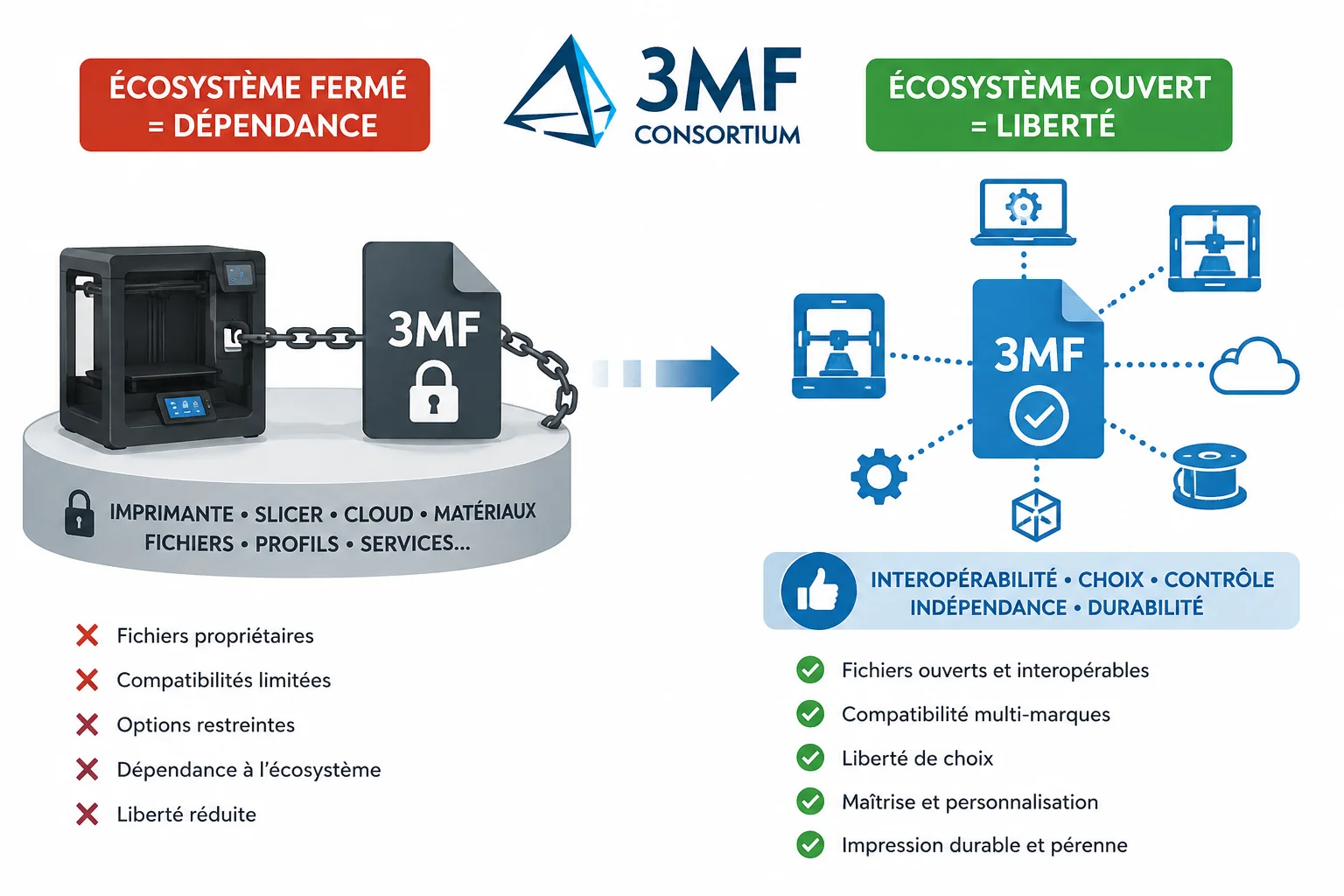
In contrast, the 3MF format allows for the transmission of much more information within a single file or project: geometry, materials, colors, configurations, and—depending on the application and software—printing parameters. This wealth of information is technically significant. In particular, it makes it possible to share projects that are much more comprehensive than a simple geometric file. But it also introduces a new challenge: The more information a file contains that is specific to a particular software or hardware environment, the more likely the user is to depend on that environment to use the project properly.
The file is then no longer just a 3D model. It gradually becomes a preconfigured print job.
And this difference is fundamental.
Key Takeaway — A richer file isn't necessarily a more open file
The 3MF format can carry more information than an STL file. That is precisely what makes it so valuable. But the more data a file contains that is tied to a specific machine, slicer, material, or ecosystem, the more it can shift some of the user’s decisions to the environment imposed upon them.
The functional richness of a format and user freedom are two different issues.
3. The «print-ready» project: great for the user, but much less educational for the maker
Let's consider a very simple case.
A user downloads a 3MF project designed for a specific machine. The file may already contain a print configuration tailored to that machine, the slicer being used, a specific material, and possibly a multicolor setup. The user no longer necessarily needs to understand why these settings were chosen.
He just has to use them.
That is precisely where the paradox lies.
Users can become extremely efficient at making objects while remaining relatively unaware of how 3D printing actually works.
He knows how to use the solution but doesn't necessarily understand the problem.
4. The Maker's Paradox: Knowing How to Print Without Knowing How to Calibrate a Printer
Today, we find ourselves in a situation that would have been hard to imagine in the early days of consumer 3D printing: You can own a 3D printer, produce objects on a regular basis, and still be unable to properly configure a print outside of the profile provided by your ecosystem.
Is it possible to understand the content of a book without knowing how to read? Probably, yes—but with the help of an audiobook.
Of course, this doesn’t mean that the user is any less intelligent, but to put it simply, they understand the author’s intent just by clicking the “read” button—and that will never make them a grammar or spelling purist.
This is the logical consequence of changes in user interfaces. Modern machines have taken on a considerable portion of the technical complexity. Profiles are preconfigured. Settings are automated. Materials can be identified. Template libraries offer ready-to-use designs. The software is taking on an increasing share of the decision-making.
The result is fantastic and so user-friendly.
But it has a devastating side effect: The user no longer has to figure out what happens when they click the «Print» button.
A very real personal experience
A friend just received a particularly impressive gift for her birthday: a semi-professional 3D printer with a state-of-the-art “multipass” system—all without any filament (it seems the manufacturer is taking a while to send the set of spools that were originally included in the package…)
She had never used a 3D printer before.Passionate about what she does, she’s incredibly comfortable with her DIY projects. With experience in laser cutting, among other things, as well as in sewing, she’s perfectly capable of picking up new techniques. However, when it comes to deviating from the machine’s preset path and understanding what it really means to adjust a print setting, the challenge becomes considerable.
Why can't I use a standard spool for an initial test? Why won't the “print bed” come off? Why adjust the temperature? What does changing the print speed actually do? Why is the orientation of a part important? What does adjusting the extrusion speed mean? Why might an identical part behave differently when printed with two filaments that are supposedly made of the same material?
These questions may seem basic to even a relatively inexperienced maker. But they are by no means basic to someone who is discovering 3D printing through a system that was specifically designed to prevent them from having to ask these questions.
So the problem isn't the user. The problem is that the tool can become so simple that it no longer reveals the knowledge needed to operate it.
A machine that spares the user from having to understand how it works is an excellent consumer product. It doesn't necessarily turn a user into a maker.
5. A simple machine isn't necessarily a bad tool
We need to be clear on this point: automation is not the maker’s enemy. Auto-calibration, defect compensation, material management, print monitoring, and the automation of certain operations are genuine advances. No one would seriously regret having to manually adjust every parameter that a modern machine can handle correctly on its own—except maybe me.
The problem arises when Automation is becoming opaque. A maker should be able to take control at any time.
Understand.
Edit.
Experiment.
Change the slicer.
Change the material.
Switch to a different machine or brand.
And, above all, understand why the result changes.
The real problem isn't automation
Automation helps eliminate tedious tasks and significantly improves the accessibility of 3D printing. It becomes problematic when it transforms knowledge that is accessible to the user into invisible decisions made by the system.
Automating a task does not mean eliminating a skill. Making it incomprehensible, however, can prevent people from acquiring it.
6. The Specific Risk Posed by Closed Ecosystems
This is where the issue of 3MF becomes particularly interesting.
An STL file contains relatively little information. But it is precisely this lack of information that gives it a high degree of neutrality:
👉🏻 The designer provides the geometry.
👉🏻 The user then takes control again.
👉🏻 He chooses his slicer, printer, material, and settings.
With a significantly enhanced 3MF project designed around a specific ecosystem, some of this flexibility can be shifted to the project designer, the slicer, or the printer manufacturer.
👉🏻 This gives the user a more immediate experience. But they may gradually lose some of their autonomy.
👉🏻He no longer necessarily chooses how to print the template; he simply follows a setup that has been prepared for him.
The difference is subtle, but fundamental to the maker culture.
7. Multicolor printing further accentuates the phenomenon
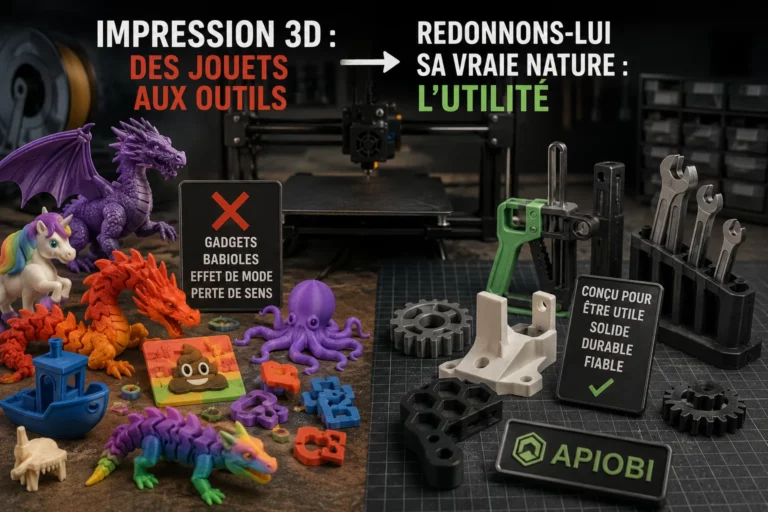
Multicolor printing is probably one of the best examples of this trend. Whether for figurines, dragons, characters, decorative items, or promotional items, the benefits are clear. The 3D project can incorporate the geometry, colors, materials, and settings required for a particularly complex print. The user then achieves a spectacular result with minimal effort.
But this approach fits much less naturally with the concept of a functional equipment.
In a functional room, color is generally a secondary consideration. It can be useful for identifying a room, distinguishing between different elements, or addressing a specific constraint. But it does not necessarily justify the implementation of a complex software and hardware system.
Moreover, the real challenge of functional printing generally lies elsewhere: geometry, orientation, tolerances, assembly, mechanical strength, material, infill, perimeters, and conditions of use.
Technological innovation is therefore real, but its value must be assessed depending on the item to be produced, rather than the available technology.
8. The maker then risks becoming merely a user of profiles
This is probably one of the most significant consequences of this trend. A traditional maker gradually develops a technical understanding and comes to realize that:
👉🏻 A filament is not just a color; ;
👉🏻 A printer isn't just a product code; ;
👉🏻 A slicer isn't just a «print» button; ;
👉🏻 A 3D model is not necessarily an object ready for manufacturing.
He learns how these elements interact; he experiments, makes mistakes, corrects them, and gradually becomes independent and exercises his free will.
Conversely, a user confined to preconfigured profiles can be extremely effective as long as everything operates within the intended framework. But as soon as a problem falls outside that framework, the user may find themselves at a loss.
It's a different skill.
And it isn't necessarily the one that has historically been associated with the term «maker.».
The Paradox
The new 3D printers are probably easier to use than ever.
However, this ease of use can lead to users who are more knowledgeable produce but not as good understand.
This is probably one of the most interesting paradoxes of modern 3D printing.
9. Why ApiObi Supports the STL
This is also why ApiObi favors the STL as much as possible for its functional models. This is not to claim that the STL is technically superior to the 3MF in all uses. That would be incorrect. The 3MF is a richer format and can be extremely useful for certain projects.
Our choice is based on a different rationale: technology neutrality. We don’t design our models for a printer brand. We don’t design them to force users to use a specific slicer. We don’t want to force users to use a specific filament. We don’t want to turn our files into vehicle for product placement. We design equipment for users.
Whether they have a new machine or an older FDM printer.
Whether they use one slicer or another.
They should print using the material of their choice, provided it is technically suitable.
The file should serve the user, not the other way around.
10. The Real Issue: Preserving the Freedom to Learn
Advocating for open files does not mean advocating for complexity for its own sake. The goal is obviously not to make 3D printing unnecessarily difficult.
The goal is to ensure that anyone who wishes to do so can understand and make progress.
A beginner should be able to get started easily, but should also be able—in the future—to edit their profile, try a different slicer, switch materials, use a different printer, or figure out why a print fails.
Simplicity should be a gateway to mastery, not a substitute for mastery.
That's probably where the difference lies between a consumer of printed materials and a true maker.
Conclusion — A 3D printer should not become a black box
3D printing was built on a philosophy that is profoundly different from that of traditional consumer devices. It is based on experimentation, knowledge sharing, interoperability, and the user’s ability to adjust settings and understand their tool.
New generations of machines are making this technology significantly more accessible, and in some respects, that's a great thing.
But this democratization must not lead to a gradual loss of autonomy.
A maker shouldn't just know how to start a print. They should be able to understand why it works—and why it fails.
That is precisely why ApiObi advocates for open, functional, and technology-neutral 3D printing.
Models designed for users, not for a brand.
Files that remain usable beyond a single ecosystem.
Above all, a simple philosophy:
We want to give you the tools you need to use your 3D printer freely.
We advocate for 3D printing as a tool for independent manufacturing, one that gradually elevates ordinary users and passionate hobbyists to the status of independent makers, and then, perhaps one day, to that of skilled designers, capable of designing equipment that technically meets the constraints and taps into the incredible potential of 3D manufacturing.
Let's hope that a 3D printer remains a workshop and never turns into a 3D printing service box. In this dystopia, designers and makers, weary of the struggle, will abandon their positions in favor of manufacturers who rent out disposable 3D-printing boxes and users who are billed based on the weight of filament consumed.


 Français
  English
  Español