
🚀 Download Platform | 🔒 Secure Payment | ⚙️ 3D Files for Recreational Equipment | 🏆 3D Models Designed for Additive Manufacturing | 2D, 3D, STL, SVG, PDF... | ❤️ Core Values | 💬 Tips, Tricks, and Discussions
Designer, publisher, manufacturer: Who is responsible for a 3D model sold on a marketplace?

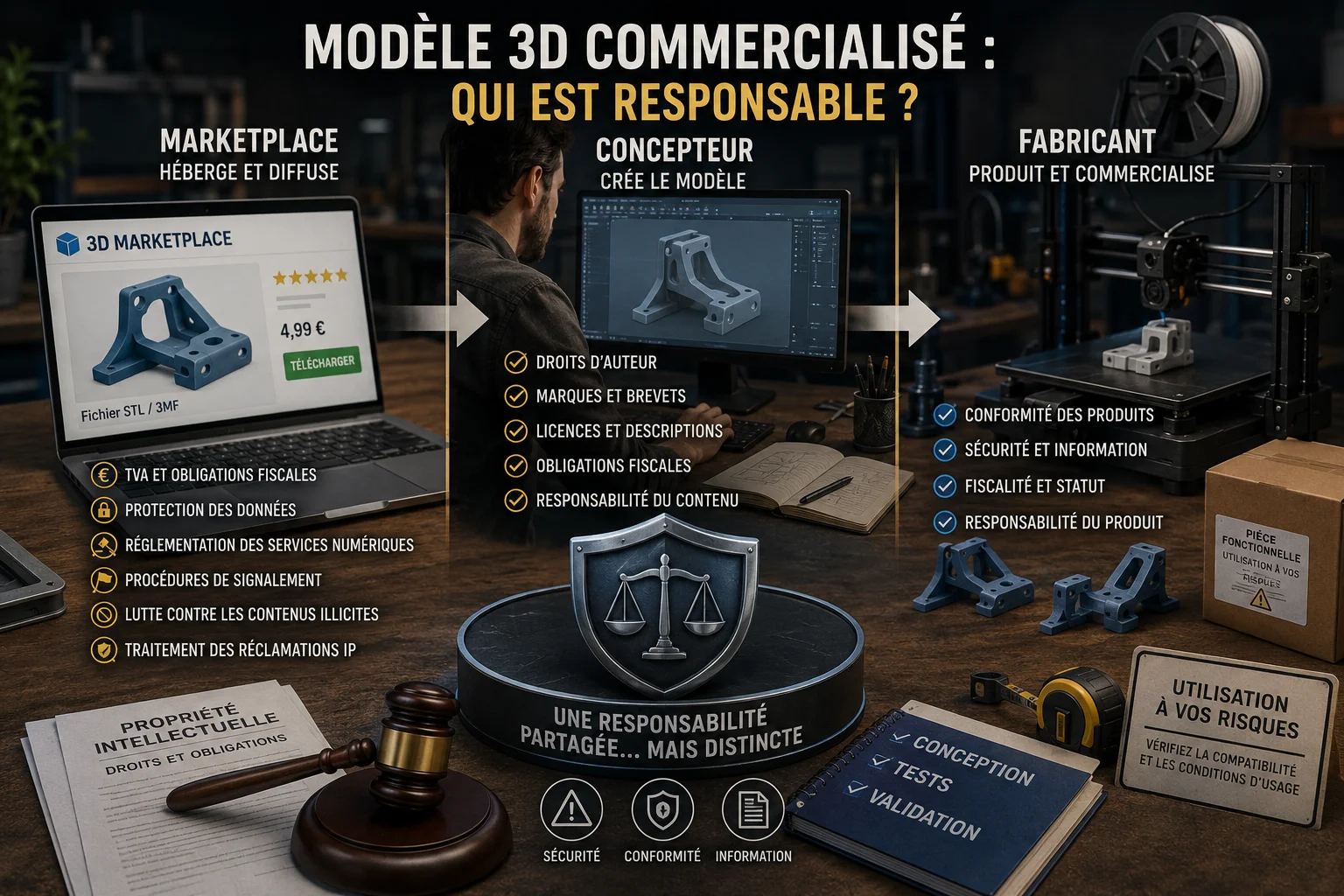
The Legal Responsibilities of Download Platforms, Designers, and Manufacturers in 3D Printing
Introduction
Publishing a 3D model on an international marketplace has become surprisingly easy. It takes just a few clicks to make an STL or 3MF file available to thousands of users around the world. However, this ease of use can give rise to a misconception: that the platform is responsible for the models it hosts.
The reality is much more nuanced.
A marketplace, a designer, and a manufacturer do not perform the same work or have the same responsibilities. Understanding this distinction has become essential as 3D printing has established itself as a legitimate means of production.
Two jobs… three responsibilities
In the world of 3D printing, there are generally three key players.
- The marketplace.
- The designer.
- The manufacturer.
They all play a part in making a product available, but their roles are fundamentally different.
The platform provides a technical infrastructure that enables users to host files, manage their distribution, and, in some cases, process payments.
The designer conceives, draws, and develops the digital model.
Finally, when the printed item is sold, a third role emerges: that of manufacturer or distributor of the physical product.
These three functions can be performed by different people… or by a single company.
The Responsibilities of a Marketplace
Download platforms are themselves subject to numerous legal obligations.
Depending on their country of operation and the markets in which they operate, they must, in particular, ensure:
- the management of their VAT and tax obligations; ;
- the protection of personal data (including the GDPR in Europe); ;
- compliance with regulations governing digital services; ;
- the implementation of procedures for reporting illegal content; ;
- the fight against certain prohibited or regulated sales; ;
- the handling of intellectual property claims.
These obligations primarily concern their role as a platform. However, they do not mean that every product listed online undergoes a thorough technical or legal review. Unless the platform creates confusion about its role by giving the impression that it is the sole seller (Art. 6.3 of the DSA).
What Platforms Cannot Guarantee
No marketplace can reasonably verify every single file that is published.
It cannot certify:
- the mechanical strength of a model; ;
- its regulatory compliance in each country where it is broadcast;
- its safety in use; ;
- the quality of its design; ;
- the absence of any intellectual property rights that could be invoked in each country.
Platforms implement procedures for monitoring, moderating, and removing content, but they remain, above all, technical intermediaries.
Their role is not that of an engineering firm, a testing laboratory, or a law enforcement officer.
The designer remains responsible for his work
The designer remains responsible for the models he or she releases, and this responsibility may include, in particular:
- respect for copyright; ;
- registered trademarks; ;
- patents; ;
- protected designs; ;
- product descriptions; ;
- the proposed operating licenses; ;
- the tax obligations related to its business.
Listing on an international marketplace does not change these responsibilities. The file is hosted by a different provider. No author.
Pen name, avatar, or trade name
Many designers publish their work under a pseudonym, a brand name, or a username. This practice is quite common and is often done for communication or confidentiality purposes. However, it does not affect their legal liability in any way.
When a model is made available for sale, its creator remains identifiable through various means: information provided to the platform, payment methods, accounting requirements, or legal proceedings, should they become necessary.
In other words, publishing under a pseudonym does not transform a professional activity into a private one. A pseudonym protects a public identity.
It in no way eliminates the obligations associated with a commercial activity.
The most sensitive model categories
Certain models naturally expose their designers to increased liability. This is particularly true for:
- auto parts; ;
- personal protective equipment; ;
- climbing gear; ;
- weapon components or similar items; ;
- medical devices; ;
- products that reproduce protected works.
The more likely an object is to affect safety or infringe on the rights of a third party, the greater the need for caution during its design and marketing.
What happens if a user has an accident?
This issue is rarely discussed. Yet it is essential.
Let's imagine that a user buys a 3D-printed auto part, a mechanical accessory, or equipment designed to combat Asian hornets.
In the event of an accident, several parties may be held liable: the model’s designer, the manufacturer of the physical product, the seller, and possibly other parties, depending on the circumstances.
There is no automatic transfer of liability to the marketplace.
The applicable law will depend, in particular, on the nature of the product, its intended and reasonably foreseeable use, the information provided to the user, the existence of any sector-specific regulations, and the link between the alleged defect and the damage.
Directive (EU) 2024/2853, which incorporates digital manufacturing files (CAD/STL) into the legal definition of software treated as products for the purposes of liability for defective products, is particularly relevant in this context: Once it takes effect, it will explicitly recognize digital manufacturing files as products under certain circumstances. In particular, it targets files used to control 3D machines or printers to manufacture an object whose defectiveness causes damage.
3D printing, therefore, does not eliminate the chain of responsibility. It shifts it and makes it more complex.
When the Designer Also Becomes the Manufacturer
The situation changes again when the designer sells printed objects based on their own models or downloaded files directly. In that case, they are no longer merely distributing a digital work.
He brings a physical product to market.
Depending on the nature of the products being sold, this business activity may entail additional obligations, such as product compliance, consumer information, taxation, intellectual property, environmental regulations, or specific requirements applicable to certain product categories.
This distinction is fundamental.
The same model can be sold as a digital file or as a printed item, but the associated liabilities are not the same.
1. First scenario: a technical document whose author or manufacturer cannot be clearly identified
This is a particularly interesting case involving 3D printing.
Let’s imagine an individual who manufactures and sells a part intended for use on a vehicle: a bracket, a fastener, a body part, or a mechanical component. Or, in another field, a trap designed to capture Asian hornets and marketed as a functional, tested, and effective device.
The first issue isn't necessarily whether the object is «3D-printed.» It is determining who designed the product, who manufactured it, under what name it is sold, and what it is intended to be used for.
The European General Product Safety Regulation (GPSR), which has been in effect since December 13, 2024, requires manufacturers, among other things, to identify their products and provide their name or brand, as well as their contact information. It also mandates a risk assessment and appropriate safety information.
Anonymity or the lack of clear identification therefore does not provide protection. On the contrary, The lack of traceability can become an additional problem when a product is hazardous or an accident occurs.
The situation is even more interesting when it comes to digital manufacturing files. The new European directive on liability for defective products, which must be transposed by December 9, 2026, and will apply to products placed on the market on or after December 9, 2026, explicitly provides for the inclusion of digital manufacturing files when they contain the functional information necessary for the automated manufacturing of an object, particularly through 3D printing.
This means that, in the long run, the distinction between a «digital file» and a «product» could end up offering professional designers much less protection than one might imagine.
So the question is no longer just, «Who printed this part?» but also, «Who designed it and provided the information needed to manufacture it?»
The Specific Case of the Automobile
However, we should avoid making generalizations: not all automotive parts are subject to the same rules.
Certain categories of vehicles, components, and equipment are subject to specific European type-approval rules. Regulation (EU) 2018/858 governs, in particular, the placing on the market of certain components and separate technical units intended for the vehicles in question, including certain replacement parts.
A 3D-printed part intended for a car does not, therefore, automatically become an «approved automotive part» simply because it physically fits the vehicle.
The intended use, the function of the room, and its regulatory category are key factors.
For a beekeeping accessory intended to combat the Asian hornet, the reasoning is different: it will be necessary to determine the exact nature of the product, its intended use, the claims made by the seller, and any applicable industry regulations. Here again, the mere fact that it is 3D-printed does not exempt the seller from its safety obligations.
2. The «individual» who is, in fact, engaged in a professional activity
Of course, an individual may occasionally sell certain personal items. But a person who designs products, manufactures them on a recurring basis, photographs them, describes them, regularly offers them for sale, promotes them, and generates revenue from them is in a very different situation.
Simply checking the «private seller» box on a marketplace does not automatically make that transaction a sale between private individuals.
And if the declared status is intentionally inaccurate in order to avoid professional commissions, fees applicable to professional sellers, certain disclosure requirements, or the corresponding tax and social security obligations, the nature of the problem changes.
Article L. 121-4(11) of the Consumer Code automatically classifies as a misleading commercial practice the act of a business operator disguising itself as a private individual. Certain representations that are false or likely to mislead the consumer regarding the professional's identity, qualities, or skills.
The DSA also promotes greater traceability: for marketplaces that allow consumers to enter into contracts with businesses, Article 30 specifically requires platforms to collect certain information that identifies the businesses using their services.
Of course, this does not mean that every active seller is automatically considered a professional. It is the reality of the business that must be examined.
And this distinction becomes particularly important when the seller is no longer content to simply resell an item occasionally, but designs a product himself, manufactures it, and markets it under his own name or brand.
In this case, do not confuse the following:
«I'm registered as an individual on the platform»
featuring:
«Legally speaking, I am considered an individual for all purposes related to my business activities.»
The first is information reported to a platform.
The second relates to the legal and economic realities of the business.
3. What if the seller manufactures the product themselves?
The GPSR defines a manufacturer as a person who manufactures a product or has it designed or manufactured and markets it under its own name or brand. It requires economic operators to place only safe products on the market.
In other words, in some cases, the reasoning goes as follows: «I didn't create the file; I just downloaded it and then printed it.» is not necessarily sufficient to waive the obligations associated with placing the physical product on the market.
You have to take a look who sells what, under what name, for what purpose, and under what conditions.
This is especially important for technical parts.
Selling on Etsy, Leboncoin, or other platforms doesn't change the rules
General-purpose platforms allow both individuals and professionals to sell printed items. It is therefore up to each seller to correctly declare their status and conduct their business in accordance with applicable regulations.
In practice, platforms do not always have the means to verify the economic reality of each business activity. As a result, there may be a discrepancy between the status declared by certain sellers and the actual nature of their business. This issue extends far beyond the field of 3D printing alone and now affects all online commerce between individuals and businesses. However, liability for the product sold remains independent of the medium used to market it.
Selling an item through a marketplace does not transfer the manufacturer's obligations and significant liabilities to the website.
A responsibility that increases with the level of professionalism
The more a designer develops functional equipment intended for actual use, the higher their standards must be.
In particular, this involves:
- clearly define the intended use; ;
- design with mechanical constraints in mind; ;
- build prototypes; ;
- conduct tests; ;
- document the limitations on use; ;
- provide users with accurate information.
The technical quality of a model is obviously a selling point. It also helps mitigate legal risks.
ApiObi's Philosophy
At ApiObi, we believe that a 3D model is more than just a digital file. It is a true design product. Before being released, each model undergoes a development process that includes design, prototyping, testing, iterative improvements, and validation under real-world conditions.
This approach is not intended to eliminate all risk—no serious designer would claim otherwise.
On the other hand, it reflects a strong conviction: a professional cannot hide behind a marketplace and ignore the consequences of their work. Taking responsibility for designing functional equipment means, first and foremost, understanding the chain of responsibility and often refraining from distributing digital content in order to comply with the law, respect trademarks and intellectual property rights, and ensure user safety.
An important clarification
This article outlines the key principles that generally apply to download platforms, designers, and manufacturers in the field of 3D printing.
This does not constitute legal advice. Regulations vary depending on the country, the seller’s status, the nature of the products being sold, their intended use, and many other factors that are undoubtedly beyond the scope of my layman’s analysis.
A marketplace can provide a sales platform. It does not provide a substitute business identity, technical certification, liability insurance, or an automatic transfer of the designer’s or manufacturer’s obligations.


 Français
  English
  Español