🚀 Download Platform | 🔒 Secure Payment | ⚙️ 3D Files for Recreational Equipment | 🏆 3D Models Designed for Additive Manufacturing | 2D, 3D, STL, SVG, PDF... | ❤️ Core Values | 💬 Tips, Tricks, and Discussions
After 3MF: What Does the Future Hold for Designers, Marketplaces, and 3D Printer Manufacturers?

Introduction
The advent of enriched 3MF files, increasingly automated slicers, and printers capable of handling a growing number of print parameters likely marks a new stage in the evolution of 3D printing.
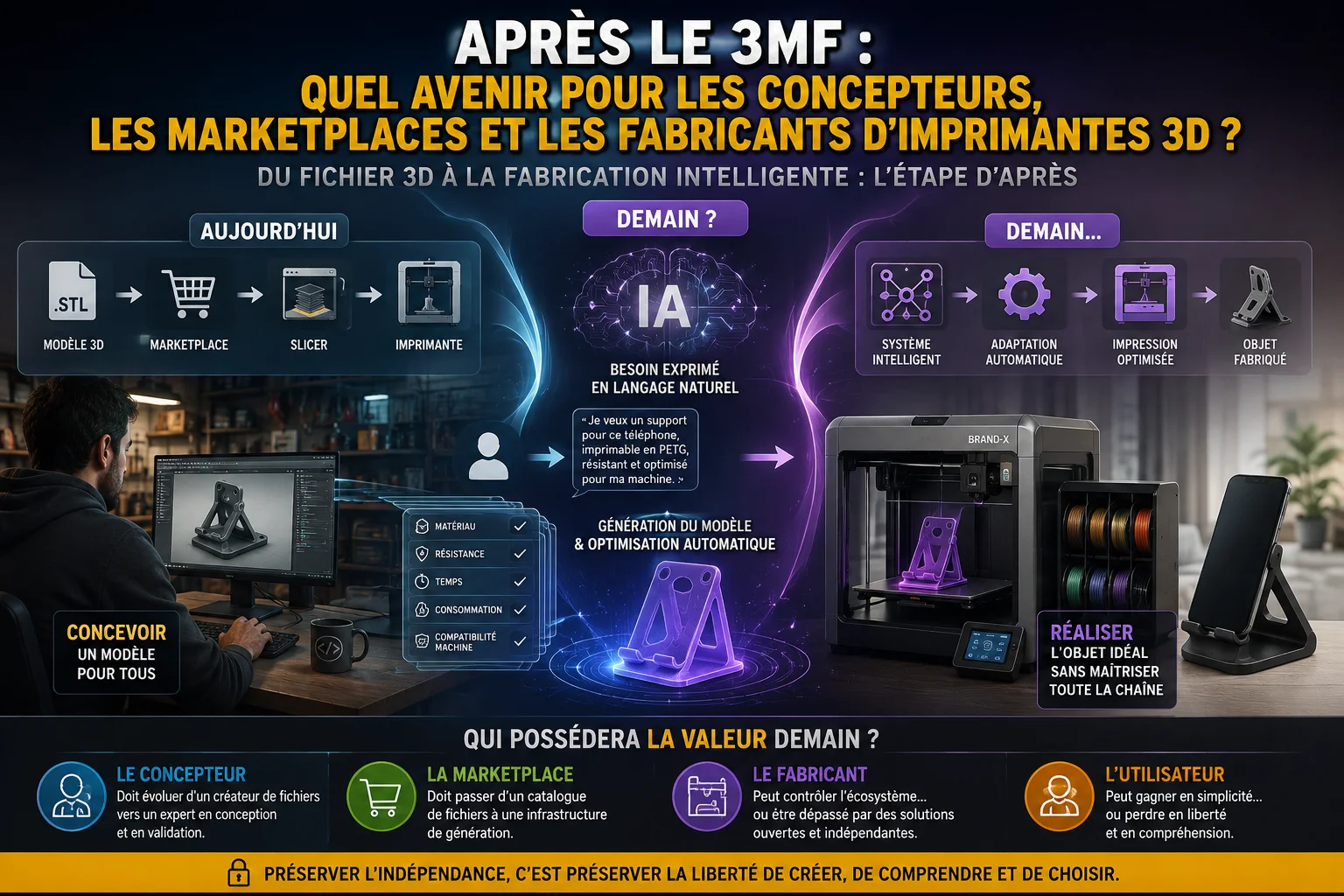
Until now, the production process has been relatively straightforward: Designer → 3D model → marketplace → user → slicer → printer
But this channel could gradually evolve into: User → need → AI → generated model → automatic optimization → slicer → printer
And, eventually, perhaps even toward: User → need → manufacturing system → object
In the latter case, the 3D file itself might become almost secondary.
It is this development that is worth noting. Because behind the growing automation of 3D printing lies a much more important issue: What will become of designers, marketplaces, printer manufacturers, and users when software is capable of handling an increasing portion of the design and manufacturing process?
1. First step: 3MF becomes a full-fledged manufacturing project
The 3MF file does not contain only 3D geometry. In a highly integrated environment, a project can also include information about colors, materials, print settings, and the configuration for the slicer and the printer. The file gradually becomes a digital manufacturing process.
For the user, the advantage is clear: fewer settings to master and a more intuitive experience.
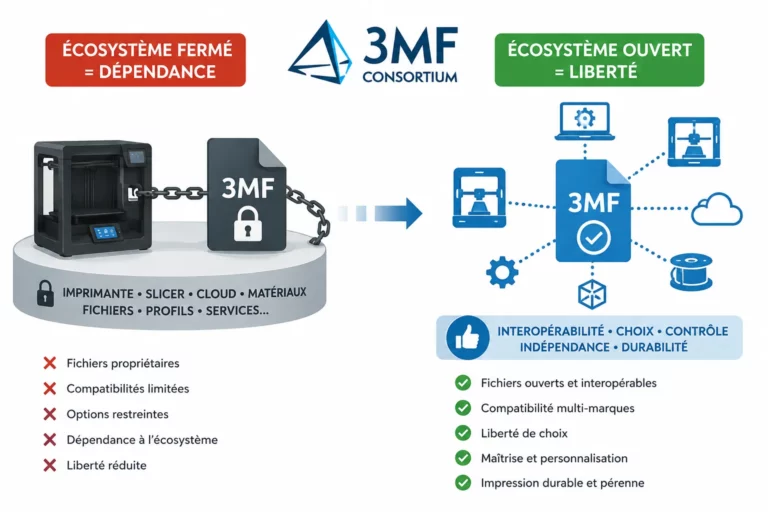
For the printer manufacturer, this development is also strategic. The more precisely a file leverages the capabilities of its machine and software, the more the user experience naturally becomes dependent on the ecosystem.
But this line of reasoning also opens up another possibility: a file that can automatically adapt to different machines.
2. Step 2: The model becomes «multi-machine»
Why would it be necessary to create a separate file for each printer?
It is possible to imagine models capable of supporting multiple configurations:
One model → multiple machines → multiple materials → multiple profiles.
The file could identify the capabilities of the machine being used and automatically select an appropriate printing strategy.
Does a machine have a smaller tray? The model adjusts its strategy.
Does another one have multiple extruders? The file can take advantage of this capability.
Does a third one have different cooling or temperature characteristics? The profile can be adjusted.
We would then move from the model «ready to print» based on the model «compatible with the printer».
Paradoxically, this could bring net neutrality back to the center of the debate, but with one fundamental difference: It would no longer necessarily be the user who makes the adjustment. It would be the software.
3. Step 3: The slicer gradually becomes a decision-making tool
Today, the slicer primarily converts a 3D model into instructions that a printer can use. But this function could gradually expand. The software can already control many manufacturing parameters.
Eventually, users could delegate an ever-increasing share of decisions regarding:
- the orientation of the part; ;
- the media; ;
- the thickness of the walls; ;
- filling; ;
- the thermal parameter chain; ;
- speed; ;
- the material; ;
- manufacturing strategies; ;
- or even certain geometric adjustments.
At this point, the user is no longer actually configuring the printer. It sets a performance goal.
The software then determines how to achieve it.
This development is extremely user-friendly for beginners. However, it raises a key question for the maker community: What remains of understanding and technical proficiency when most decisions are made automatically?
4. Step 4: The AI generates the model itself
This is probably where the role of the designer could be profoundly transformed, as users might no longer search for a specific model in a library.
It could simply express a need:
«I want a support structure that will hold this object in place, that can be printed in PETG on my printer, and that can withstand a certain load.»
The system could then generate appropriate geometry.
It could potentially take into account:
- the required dimensions; ;
- the available material; ;
- the machine's capabilities; ;
- mechanical stresses; ;
- print time; ;
- the amount of matter.
The 3D model would then become a tailored solution to a need, rather than an object designed once and then distributed to thousands of users. And that is when the traditional role of the designer is directly called into question.
5. The Next Step: Models That No Longer Actually Exist
This may be the most radical perspective.
Today, a marketplace sells or distributes a file: support_X.stl
Tomorrow, a user might ask: «Generate a template for me that's tailored to my needs, my machine, and the material I have available.»
The system could then produce: X_Bracket_for_Y_Machine_Made_of_Z_Material.stl, and then, if necessary, automatically prepare it for printing.
The file might not even be kept as a standalone product. The product being sold would no longer actually be the 3D model. It would be its generation.
This development would fundamentally challenge the current business model of file-sharing marketplaces.
6. What about general-purpose marketplaces in all of this?
This is probably one of the most important questions.
Platforms such as Cults3D, Thingiverse, Printables, and Thangs have historically built part of their value around a catalog-based model.
👉 Designers create.
👉 The go-to platform.
👉 Users are searching for.
👉 They're downloading.
But what happens to a platform when users no longer need to search for a file?
If an AI can directly generate a model tailored to its needs, the catalog may lose some of its importance.
The value could then change: from the catalog to the algorithm.
Platforms will therefore need to evolve if they want to maintain a central role in this new chain.
7. The Best-Case Scenario: Platforms Become Design Infrastructures
This evolution does not necessarily mean that marketplaces will disappear. On the contrary, they could evolve into much more sophisticated platforms.
The designer would continue to contribute:
- his expertise; ;
- its models; ;
- its concepts; ;
- his or her professional knowledge; ;
- his essays; ;
- its validations.
Artificial intelligence could use this material to generate variations and meet specific requests.
In this scenario, The designer doesn't disappear—he simply takes on a different role.
It is becoming more of a provider of design and validation insights than a mere producer of STL files.
8. The intermediate scenario: the manufacturer becomes the platform
This is probably where the issue of proprietary 3MF files becomes truly strategic.
If a manufacturer has mastered: the printer + the firmware + the slicer + the profiles + the materials + the files + the marketplace + the AI, it potentially controls a large part of the digital manufacturing chain. The manufacturer is then no longer just selling a printer. It potentially controls the complete manufacturing environment.
This raises a fundamental question:
So who has the relationship with the user: the designer, the marketplace, or the manufacturer?
9. The critical scenario: the designer becomes merely a source of data
This is probably the scenario that independent developers need to pay the closest attention to.
A platform has access to a wealth of information from its ecosystem: published models, downloads, ratings, comments, print settings, and user behavior.
While this data enables automated systems to gradually improve, the designer can continue to produce content while the platform accumulates the knowledge needed to automate part of the design process.
Eventually, the system could become capable of generating models that directly meet users' needs.
The platform could then gradually reduce its dependence on the designer as a seller of models, even though it had relied on the designer to build its knowledge base.
This is a potential reversal of the balance of power.
10. What about 3D printer manufacturers?
The manufacturer could be one of the big winners in this development.
He wouldn't just be selling anymore: a machine.
He is said to be selling: manufacturing capacity.
The user would buy a printer because it could automatically turn a request into an object.
From there, the value could gradually shift toward:
- consumables; ;
- materials; ;
- accessories; ;
- services; ;
- software features; ;
- subscriptions; ;
- models or their automated generation.
The printer would finally become a production terminal integrated into a digital ecosystem.
11. But the most interesting scenario might be the opposite
However, there is another possibility. Artificial intelligence technologies could also reduce the importance of proprietary ecosystems. A truly independent AI could theoretically analyze: the machine + the material + the slicer + the constraints + the model – and develop a tailored strategy without relying on a specific manufacturer.
The model could then truly become multi-machine and multi-technology.
In this scenario, the technology neutrality advocated by ApiObi would take on new significance. The file would no longer be tied to a specific printer.
It is believed to be linked to an intent to manufacture.
12. So, who stands to lose?
That’s probably the question that needs to be asked, and the answer isn’t necessarily the designer. It all depends on how this transition is organized.
The designer may lose
If it simply becomes a content provider that allows platforms to enrich their databases and automated systems.
The marketplace may lose
If it remains merely a catalog while users go directly through generation engines.
The manufacturer may lose
If it locks its users too tightly into an ecosystem, and a new generation of independent software becomes capable of enabling different machines to communicate with one another.
The user may lose
While it is gradually losing its freedom to understand, modify, and choose its manufacturing environment, it can also be the big winner if these technologies finally enable him to manufacture complex objects without having to master the entire technical process.
13. What role does ApiObi play in this development?
ApiObi probably has no interest in trying to compete with manufacturers on their own turf. The strategy may be exactly the opposite: preserve the model's independence.
A functional model must be able to survive:
- a generation of printers; ;
- to a manufacturer; ;
- to a slicer; ;
- to a material; ;
- to a marketplace; ;
- to a software technology.
The goal is not to reject technological progress, but to ensure that Changes do not render the model obsolete or lock it in. This is where the concept of technological neutrality becomes much more than just an editorial argument.
It has the potential to become a long-term strategy for both independent designers and users.
Conclusion — The Next Step
We may be gradually shifting from the Downloading a 3D model at the automatic generation of a manufacturing solution.
Today, users search for a file. Tomorrow, they might simply describe a need. The system could then select the geometry, material, orientation, parameters, and possibly the machine.
At that point, the question will no longer be just:
«Who owns the file?»
It will become:
«Who possesses the intelligence needed to make the object?»
This question could very well determine the balance of power in the next decade of 3D printing, as the 3D file may well become more than just a finished product: a transitional step toward manufacturing driven by software intelligence. In this transformation, the real challenge for an independent designer may no longer be simply to protect their files.
The goal will be to preserve the value of its design intelligence.


 Français
  English
  Español